What Is ABX (Account-Based Everything)? Definition, Model and Examples
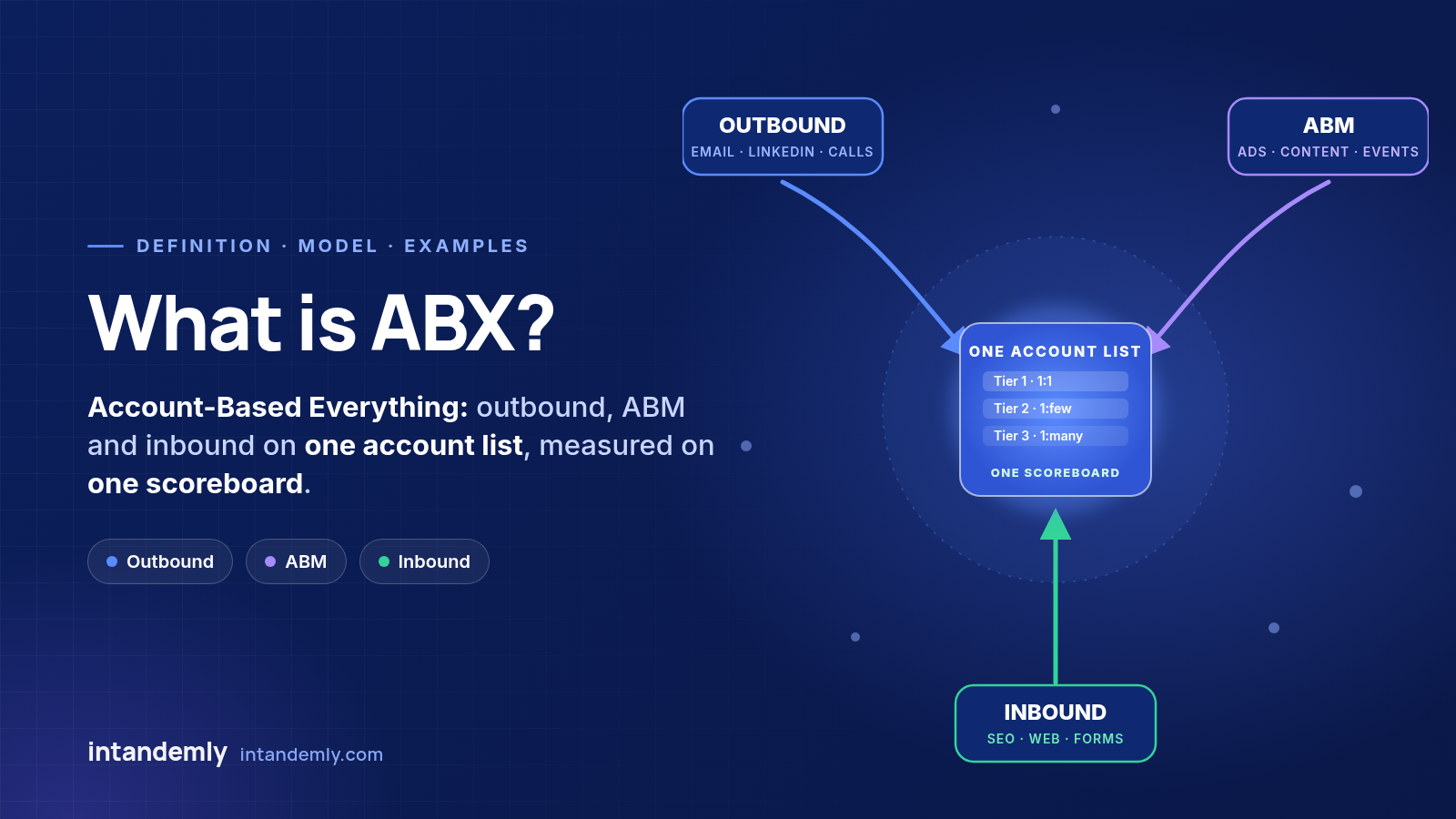
ABX (Account-Based Everything) is a B2B go-to-market model in which outbound sales, account-based marketing (ABM) and inbound all work from one shared list of target accounts and are measured on one scoreboard of account engagement, meetings and pipeline. Instead of three teams chasing three definitions of success, every channel pushes the same accounts towards the same deal.
Key takeaways
- ABX = outbound + ABM + inbound, pointed at one account list and judged on one scoreboard.
- It is not a new channel or a tool. It's an operating model: shared accounts, shared signals, shared numbers.
- "ABX" is also used to mean account-based experience, a customer-journey framing popularised by ABM software vendors. Intandemly uses Account-Based Everything because the problem most teams have is coordination, not experience design.
- ABX needs four things: an agreed account list, mapped buying groups, a weekly signal hand-off and a single pipeline report.
- The most common failure is calling it ABX while marketing still reports MQLs and sales still reports activity.
What does ABX actually mean?
Strip away the acronym and ABX is a simple idea: every revenue motion you run should be aimed at the same accounts at the same time.
Most B2B companies already do all three motions. They just do them separately:
- Outbound (SDRs, account executives, founders) emails, calls and messages people on a prospect list that sales built.
- ABM runs ads, content and events at a target account list that marketing built.
- Inbound captures whoever turns up via search, referrals and the website, and scores them as leads.
Three lists, three sets of metrics, three weekly meetings. The buyer at your best-fit account gets a cold email that ignores the webinar they attended, sees an ad for a product their team already rejected, and fills in a form that's routed to someone who has never heard of the account.
ABX fixes that by making the account, not the lead or the campaign, the unit everyone works on. In practice it means three commitments:
- One account list. Sales and marketing agree, in writing, which accounts matter and in what tier.
- One set of signals. Engagement from any channel (an ad click, a reply, a pricing-page visit, an event sign-up) is visible to everyone working that account.
- One scoreboard. Success is measured on accounts engaged, buying-group coverage, meetings, pipeline and revenue from the list, not on channel vanity metrics.
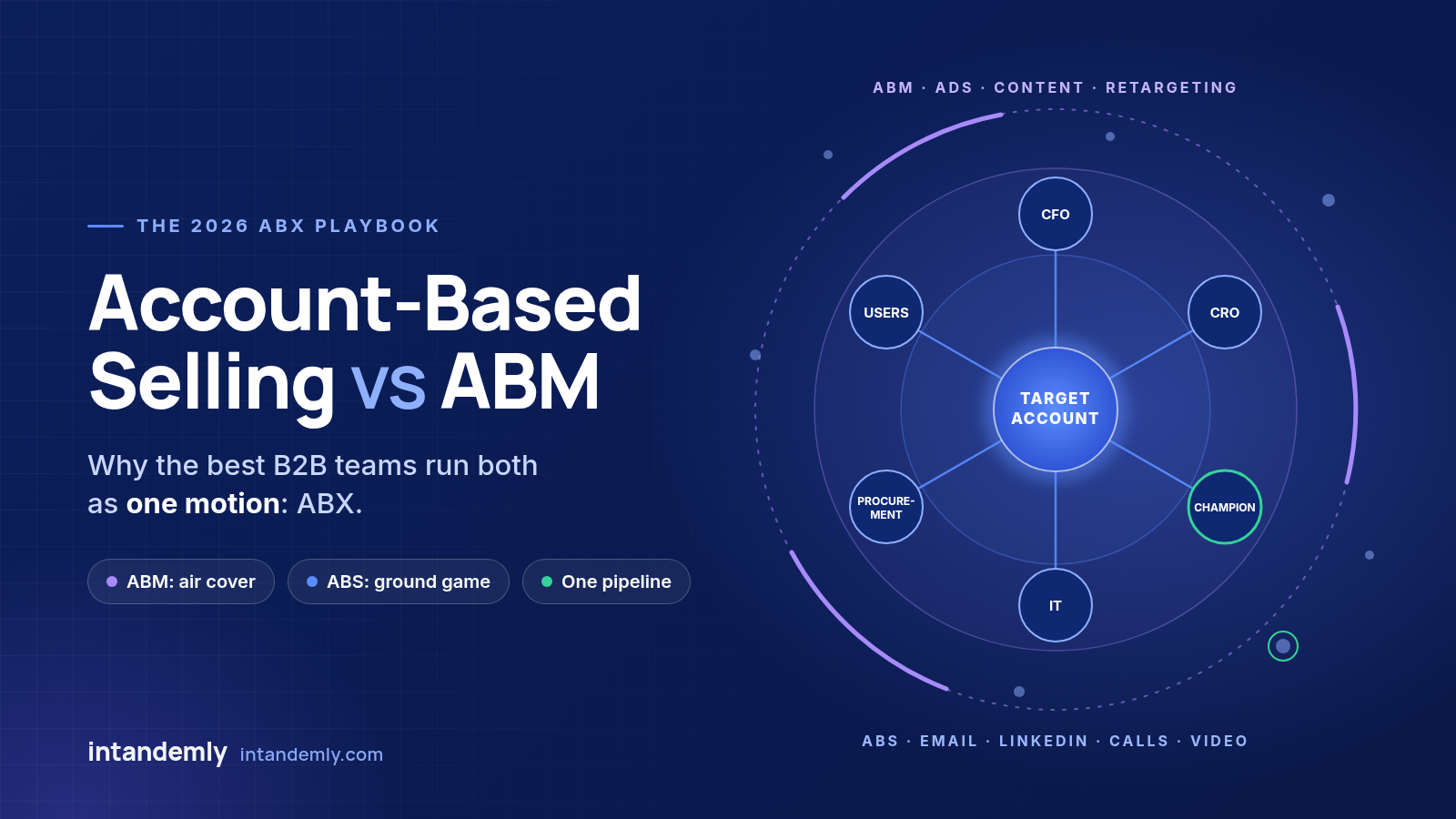
If you've read our account-based selling vs ABM playbook, ABX is the model that makes the two work as one. That guide's INTANDEM framework is the step-by-step way we run it.
INTANDEM: how we get IN to an enterprise account and work it in TANDEM, sales and marketing as one motion.
Where did the term ABX come from, and why are there two meanings?
You'll see "ABX" expanded two ways, and it's worth being precise about which one you mean.
Account-based experience. ABM software vendors such as Terminus and Demandbase have used ABX to describe a customer-centric evolution of ABM. Demandbase defines account-based experience as "a go-to-market strategy that uses data and insights to orchestrate relevant, trusted marketing and sales actions throughout the B2B customer journey", combining "the engageability of inbound marketing with the precision and targeting of account-based marketing". The emphasis is on the buyer's experience across the whole lifecycle, often orchestrated through an ABM platform.
Account-based everything. The other usage, and the one Intandemly uses, is about who does the work. Every team and every channel (outbound, ABM and inbound, plus customer success for expansion) is account-based and coordinated.
These definitions aren't enemies. A great experience is the outcome you want. But in our experience running account-based programmes since 2017, what actually stops most companies getting there isn't a lack of experience design or software. It's that outbound and marketing are working different lists and reporting different numbers. "Everything" names that problem directly, so that's the definition we build around.
ABX vs ABM vs account-based experience: what's the difference?
| ABM (account-based marketing) | Account-based experience | ABX (Account-Based Everything) | |
|---|---|---|---|
| Core idea | Marketing targets a defined list of accounts with tailored campaigns | Orchestrate a relevant, trusted experience across the buyer journey | Point outbound, ABM and inbound at one account list |
| Led by | Marketing | Marketing, usually platform-driven | Shared: sales, marketing and RevOps |
| Main channels | Ads, content, events, direct mail, web personalisation | ABM platform plays, intent data, personalised content and ads | Email, LinkedIn, calls and video (outbound) + ads and content (ABM) + SEO and website (inbound) |
| Primary unit | Account | Account journey | Account and its buying group |
| Typical metrics | Engagement, reach, influenced pipeline | Engagement, journey stage progression | One scoreboard: accounts engaged, buying-group coverage, meetings, pipeline, revenue |
| Common failure | Great air cover, nobody follows up | Strong tooling, weak sales execution | Labelled ABX, still run as silos |
| Best for | Warming high-value accounts at scale | Teams with a mature ABM platform and data | Teams that need pipeline from a named list, fast |
The short version: ABM is a motion. Account-based experience is a philosophy about the buyer journey. ABX, as we use it, is the operating model that makes every motion account-based at once. For a full grounding in ABM itself, start with what is account-based marketing. For the sales side, see our guide to account-based selling.
How does an ABX operating model work?
An ABX model answers three questions: who owns what, which accounts, and how do we keep score.
Who owns what?
| Role | Owns in ABX | Doesn't own |
|---|---|---|
| Sales leadership / AEs | Final say on the account list, deal strategy, late-stage buying-group meetings | Channel budgets |
| Outbound (SDRs / BDRs) | Multi-threaded outreach to the buying group across email, LinkedIn, calls and video | Ad targeting |
| Marketing / ABM | Air cover on the list: ads, account-specific content, events, retargeting | Lead counts as a goal |
| Inbound / web | Converting list accounts that arrive via search, content and the website; routing them to the account owner | Generic MQL volume |
| RevOps | The account list in the CRM, signal routing and the single scoreboard | Messaging |
| Strategist / ABX lead | Weekly cadence, test plan and making the three motions act as one | Individual channel execution |
In a smaller company, one person may wear three of these hats. That's fine. What matters is that each responsibility has a named owner.
One account list
Everything starts from a single, tiered target account list:
- Tier 1 (1:1): a small number of strategic accounts with fully researched buying groups and tailored outreach and content.
- Tier 2 (1:few): clusters of similar accounts (same industry, same trigger) with messaging per cluster.
- Tier 3 (1:many): a wider list worked with lighter personalisation and programmatic ABM.
Our guide to ABM account tiering covers how to score and tier accounts. The ABX rule is simple: if an account isn't on the list, no motion spends real effort on it; if it is, every motion knows.
One set of signals
Signals from every channel flow to the account owner:
- Outbound: replies, accepted connection requests, call conversations
- ABM: ad engagement from the account, content consumption, event attendance
- Inbound: website visits from the account, pricing-page views, form fills, organic search arrivals
The operational heart of ABX is a weekly signal review: which list accounts heated up this week, who in the buying group showed it, and what's the next coordinated move. A hot ABM signal should change the outbound sequence within days, not at the end of the quarter.
One scoreboard
Replace channel dashboards with one account scoreboard, reviewed by sales and marketing together:
| Stage | Metric |
|---|---|
| Coverage | % of list accounts with the buying group mapped |
| Engagement | Accounts showing engagement from any channel |
| Conversation | Accounts with at least one two-way conversation |
| Meetings | Qualified meetings with list accounts |
| Pipeline | Opportunities and pipeline value from the list |
| Revenue | Closed-won revenue, win rate and cycle length on list accounts |
Channel metrics (open rates, CTR, impressions) still exist, but as diagnostics, not goals.
What does ABX look like in practice?
These examples come from Intandemly's published client case studies.
Digitap.ai: FinTech AI, India. Digitap.ai needed meetings with high-value BFSI accounts in a crowded market. The programme combined account selection and prioritisation, messaging customised per account, multi-channel outreach across email, social and targeted advertising, and sales enablement support: outbound and ABM pointed at the same list. The result: 144 meetings against a target of 96, or 150% of the annual target. Read the Digitap.ai case study →
Lyxel & Flamingo (L&F MENA): creative and digital agency, GCC and MENA. The challenge was reaching senior decision-makers inside large enterprises, behind gatekeepers and long buying cycles. The programme identified the exact decision-makers inside large corporations and expanded from the UAE into Saudi Arabia and the wider region with sharper enterprise messaging. The result: 1,200+ accounts targeted and 37 qualified inroads in Q3 2024. Read the L&F MENA case study →
Yango Tech: India and MENA. Yango Tech's programme combined data-driven account selection, customised campaigns, account-based selling across multiple channels and buying-group engagement. Intandemly's published results: CAC down 15%, account engagement up 30%, sales cycles 20% shorter and revenue up 35% in India and MENA. Read the Yango Tech case study →
The pattern across all three: one list, a mapped buying group, coordinated channels and a scoreboard built on meetings and pipeline. None of them was "just ABM" or "just outbound".
How do you build an ABX strategy?
A workable ABX strategy fits on one page. In order:
- Agree the ICP and the list. Sales and marketing sign off the same tiered account list. (See our ABM strategy guide.)
- Map buying groups. For Tier 1 and Tier 2, name the economic buyer, champion, users, IT/security and procurement.
- Write one narrative per tier or cluster. The ad, the cold email and the landing page should tell the same story.
- Sequence the channels. Air cover first, then multi-threaded outreach, with inbound pages ready to catch the traffic. Our guide to multi-channel prospecting covers cadence design.
- Route the signals. Decide who sees what, and how fast a signal changes the next action.
- Run one scoreboard and one weekly meeting. Same numbers, same room.
- Double down and expand. Shift effort to the tiers and messages that create meetings; treat every win as a land to expand into.
This is the logic of our INTANDEM framework: Target together, Assemble the buying group, Nurture with air cover, Direct multi-threaded selling, Escalate on signals, Measure and multiply.
Are you ready for ABX? A checklist
Tick these honestly. Five or more "no"s means fix the foundations before you call anything ABX.
- Sales and marketing have signed off one target account list, with tiers.
- The list lives in the CRM, and every account has a named owner.
- Tier 1 and Tier 2 accounts have mapped buying groups (at least 3–5 roles each).
- Outbound sequences and ABM campaigns use the same narrative per tier.
- Website and inbound routing recognise list accounts and send them to the owner.
- Engagement signals from ads, web and outreach are visible in one place.
- There's a weekly signal review with sales and marketing in the same meeting.
- The headline metrics are meetings and pipeline from the list, not MQLs or opens.
- Email deliverability and LinkedIn capacity can support multi-threaded outreach.
- Leadership has agreed a realistic window (typically a quarter or more) before judging results.
What are the most common ABX mistakes?
- Renaming, not changing. The team adopts the ABX label but keeps separate lists and separate dashboards.
- Air cover with no ground game. Ads and content run at the list, but nobody reaches out to the buying group, so engagement never becomes a meeting.
- Outbound with no air cover. SDRs hit cold accounts that have never heard of you, then marketing gets blamed for "no brand".
- Single-threading. One contact per account. When that person goes quiet or leaves, the account dies.
- Lists that are too big. A "target" list of 20,000 accounts isn't a list; it's a database. Tier ruthlessly.
- Slow signal hand-offs. A pricing-page visit that reaches sales two weeks later is worthless.
- Buying a platform first. Software can scale a working model; it can't create agreement between sales and marketing.
- Judging it in a month. B2B buying cycles are long. Measure leading indicators early, pipeline later.
Frequently asked questions
What is ABX?
ABX most often stands for Account-Based Everything: a B2B go-to-market model where outbound, account-based marketing and inbound all work one shared list of target accounts and are measured on one scoreboard of engagement, meetings and pipeline. Some vendors use ABX to mean account-based experience instead.
What does ABX stand for in marketing?
ABX stands for either Account-Based Everything or account-based experience. Account-based experience, used by ABM vendors such as Demandbase, focuses on orchestrating a relevant buyer journey. Account-Based Everything, the definition Intandemly uses, focuses on making every team and channel work the same accounts together.
What is the difference between ABX and ABM?
ABM is a marketing-led motion that targets a defined list of accounts with tailored campaigns. ABX is the wider operating model: ABM plus outbound selling plus inbound, all pointed at the same account list with one shared scoreboard. ABM is one part of ABX.
Is ABX the same as account-based experience?
Not quite. Account-based experience describes a customer-centric approach to the buyer journey, usually run through an ABM platform. Account-Based Everything describes an operating model in which every revenue team works the same accounts. They share the same goal of relevant, coordinated engagement, but Account-Based Everything puts the emphasis on cross-team execution.
What is an ABX framework?
An ABX framework is a repeatable sequence for running outbound, ABM and inbound as one motion. Intandemly's INTANDEM framework has six stages: Target together, Assemble the buying group, Nurture with air cover, Direct multi-threaded selling, Escalate on signals, and Measure and multiply.
Who should own ABX?
ABX should be jointly owned by sales and marketing, with RevOps owning the account list, signal routing and scoreboard. A named strategist or ABX lead runs the weekly cadence. If only marketing owns it, it tends to become ABM; if only sales owns it, it becomes outbound.
How do you measure ABX?
Measure ABX on one account scoreboard: buying-group coverage, accounts engaged, accounts in conversation, qualified meetings, pipeline and revenue from the target list. Channel metrics such as open rates and click-through rates are useful diagnostics but shouldn't be the goals.
Is ABX only for enterprise companies?
No. ABX suits any B2B company selling high-value deals to a definable set of accounts, including startups and mid-market firms. Smaller teams run the same model with a smaller list, fewer tiers and one person covering several roles.
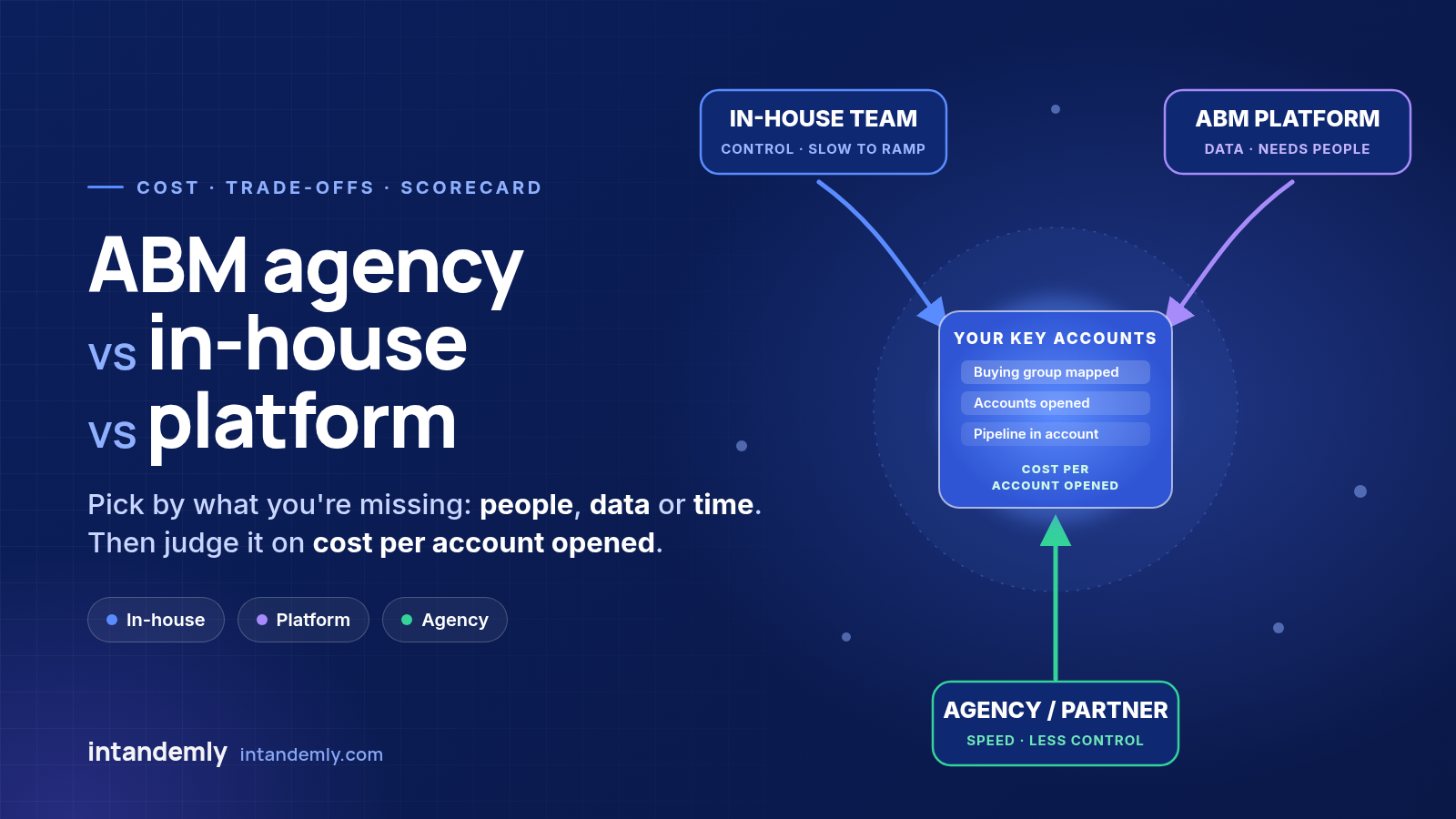
Related reading: ABM agency vs in-house team vs ABM platform: cost and trade-offs
Related reading: The INTANDEM framework: the six stages for running ABX
The bottom line
ABX isn't a new channel, and it isn't a piece of software. It's a decision: one account list, one set of signals, one scoreboard, with outbound, ABM and inbound pulling in the same direction. Teams that make that decision stop arguing about whose leads count and start counting meetings and pipeline from the accounts that matter.
Want ABX running on your target accounts? Intandemly is a managed account-based selling and ABM company that runs outbound, ABM and inbound as one ABX motion for B2B teams across India, the US, the UK and the GCC. Book a strategy session →