
The INTANDEM Framework: A Six-Stage Account-Based Selling (ABX) Framework
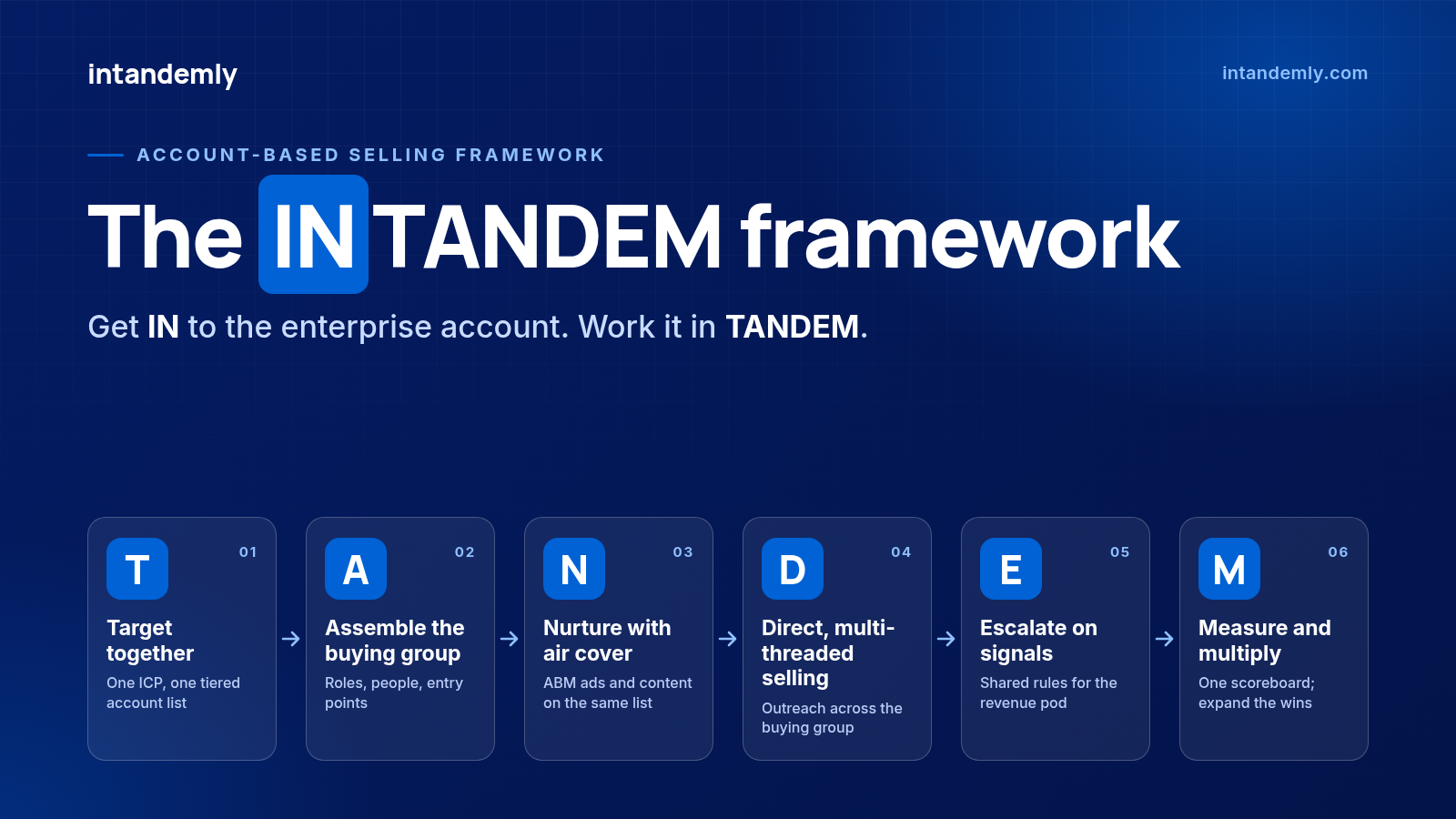
The INTANDEM framework is Intandemly's six-stage account-based selling framework for getting IN to an enterprise account and working it in TANDEM. Sales and marketing Target together, Assemble the buying group, Nurture with air cover, run Direct multi-threaded selling, Escalate on signals, then Measure and multiply. Each stage has one owner, one output and one exit test, which turns ABX from a label into an operating sequence.
Key takeaways
- INTANDEM = IN + TANDEM. Get IN to the account; work it in TANDEM across sales, marketing and every member of the buying group.
- Six stages spell T-A-N-D-E-M: Target together, Assemble the buying group, Nurture with air cover, Direct multi-threaded selling, Escalate on signals, Measure and multiply.
- The unit of work is the account, not the lead. Every stage produces something you can inspect per account: a tier, a buying-group map, a signal, a conversation, a next action.
- Stages overlap in time but not in order. Nurture and Direct run together. Nothing starts before Target and Assemble are done.
- One scoreboard. Buying-group coverage, accounts penetrated and pipeline in named accounts. Sends, opens and clicks are diagnostics.
Last updated: 9 October 2026.
A note on bias: INTANDEM is our own framework, built from the account-based programmes we have run since 2017. We say below when you don't need it.
What is the INTANDEM framework?
INTANDEM is an account-based selling framework: six stages that a revenue team runs, in order, against a named list of accounts. IN is the goal: get past a single contact and into the group that decides. TANDEM is the method: sales and marketing work the same accounts, with the same signals, at the same time.
It is also an ABX framework. ABX (Account-Based Everything) points outbound, account-based marketing and inbound at one account list. INTANDEM is the order in which you do that work.
            THE INTANDEM FRAMEWORK
   Get IN to the account. Work it in TANDEM.

   PLAN               WORK THE ACCOUNT             LEARN
 ┌─────┐  ┌─────┐   ┌─────┐  ┌─────┐  ┌─────┐   ┌─────┐
 │  T  │─▶│  A  │─▶ │  N  │◀▶│  D  │─▶│  E  │─▶ │  M  │
 └─────┘  └─────┘   └─────┘  └─────┘  └─────┘   └─────┘
  Target   Assemble  Nurture  Direct   Escalate  Measure
  together buying    with air multi-   on        and
           group     cover    threaded signals   multiply
     ▲                                              │
     └──── expand into the next division or region ─┘
T and A are planning stages: no outreach happens until both are complete. N, D and E run together while the account is active. M closes the loop and sends each won account back to stage T.
Why does account-based selling need a framework in 2026?
Because the buyer is no longer one person, and no single team can reach the whole group alone. Two published findings make the case:
- Buying groups are large. Forrester's State of Business Buying, 2026 reports that on average 13 internal stakeholders and nine external participants influence a buying decision. (Forrester, January 2026)
- Alignment around the group pays. Demandbase's State of ABM 2026 benchmark puts a typical buying group at 13–17 stakeholders and says organisations aligned around buying groups achieve up to 2–3× higher win rates than teams centred on individual contacts. (Demandbase, State of ABM 2026) This is a vendor benchmark, so read it as direction, not census.
One seller emailing one contact cannot cover 13 people, and ads alone cannot run a deal. What most teams lack is an agreed order of work: who picks the accounts, who maps the people, when marketing and sales start, and what happens when an account moves. A framework supplies that order.
What are the six stages of INTANDEM?
| Stage | Name | The question it answers | Output | Exit test |
|---|---|---|---|---|
| T | Target together | Which accounts, and in what priority? | One shared ICP and a Tier 1/2/3 account list | Sales and marketing leaders have both signed the list |
| A | Assemble the buying group | Who decides, who influences, where do we enter? | A buying-group map per Tier 1 and Tier 2 account | Roles, named people and an entry point recorded per account |
| N | Nurture with air cover | Does the group know us before we reach out? | ABM ads, content and retargeting on the same list | Target accounts are seeing account-specific content |
| D | Direct, multi-threaded selling | Are we in conversation with several stakeholders? | Coordinated outreach across the buying group | Two-way conversations with more than one role |
| E | Escalate on signals | What do we do when the account moves? | Written rules of engagement for the revenue pod | Every signal has an owner, an action and a deadline |
| M | Measure and multiply | What worked, and where do we expand? | One scoreboard and an expansion plan per won account | Budget and effort moved towards what opened accounts |
Our ABS vs ABM playbook has copy-and-paste templates for these stages. This page is the reference version.
How does each INTANDEM stage work?
Stage 1 (T): Target together
Goal: one account list that sales and marketing both work.
If marketing advertises to one list while sales prospects another, the company pays twice and covers neither.
- Define the ICP in two layers. Fit (industry, size, region, technology) and timing (new leadership, expansion, regulation, a contract ending).
- Score and tier. Tier 1 is one-to-one, Tier 2 one-to-few, Tier 3 one-to-many, each sized to the team you have.
- Publish one list to the CRM, the ad audiences and the outreach tools, with exclusions agreed.
Checklist
- ICP signed by the heads of sales and marketing
- Every account scored and tiered to team capacity
- The same list is live in every tool
Go deeper: account selection criteria, account tiering and the selection scorecard.
Stage 2 (A): Assemble the buying group
Goal: know who decides before anyone is contacted.
For each Tier 1 and Tier 2 account, map the roles, put names against them and choose an entry point.
| Role | What they care about | Typical entry point |
|---|---|---|
| Economic buyer | Cost, risk, return | A business trigger: expansion, audit, new entity |
| Champion | The daily pain your product removes | Their team's workload or hiring |
| Technical evaluator | Security, integration, data | A security or architecture pack |
| Procurement and legal | Terms, risk, vendor count | Early, clear commercial terms |
| Sceptic | The status quo or a rival vendor | Evidence, not persuasion |
Checklist
- At least four roles named per Tier 1 account
- One entry point per person, based on something true and current
- A second door identified if the first stays closed
Go deeper: how to map target accounts and the buying committee map template.
Stage 3 (N): Nurture with air cover
Goal: the buying group has seen your name, and your point of view, before the first direct message arrives.
Air cover is account-based marketing aimed at the same list from stage T and the same roles from stage A:
- Account-targeted ads and retargeting by company and job function.
- Content for the committee: a business case for finance, a security pack for IT, a peer story for users.
- Events and roundtables for Tier 1.
Checklist
- Ad audiences built from the stage T list, not a lookalike
- At least one asset per mapped role
- Engagement reported per account, not per campaign
Our guide to ABM with LinkedIn Ads covers the setup.
Stage 4 (D): Direct, multi-threaded selling
Goal: two-way conversations with several members of the buying group at once.
A single thread breaks when one person changes job, loses interest or was never the decision-maker. Each mapped stakeholder gets a message written for their role, in a coordinated sequence.
- Thread three to five stakeholders per Tier 1 account at the same time.
- Mix channels: email, LinkedIn, calls and personalised video or voice notes. We plan 12–15 touchpoints per account; that is our own planning norm, not an industry statistic.
- When one door stays closed, try the next from the stage A map.
Checklist
- Role-specific message per stakeholder
- Sequence coordinated, so two people never get the same note
- Every reply logged against the account, not only the contact
Go deeper: multi-channel prospecting.
Stage 5 (E): Escalate on signals
Goal: when an account moves, the whole revenue pod moves with it.
Signals are useless without an agreed response. Write the rules before launch:
| Signal | Who acts | What they do | Deadline |
|---|---|---|---|
| Several people from one account engage within two weeks | Sales + marketing | Start or speed up the multi-threaded play; raise ad frequency | 48 hours |
| Pricing or case-study page visit from a target account | Sales | Personal outreach on the relevant use case | 24 hours |
| Positive reply from any stakeholder | Sales + marketing | Open the conversation; ask who else should join; switch ads to proof | Same day |
| Opportunity stalls or is lost | RevOps | Log the reason; set a re-entry trigger | At review |
Checklist
- Each signal has one owner, one action and one deadline
- Alerts and tasks live in the CRM, not in a slide
- Reviewed weekly by sales and marketing in the same meeting
Stage 6 (M): Measure and multiply
Goal: learn from one scoreboard, then expand inside the accounts you have opened.
Measure at account level and move budget towards the tiers and messages that open accounts. Multiply by treating every won account as a new list: other divisions and regions go back through stage T, with a reference customer already inside.
Checklist
- One dashboard that sales and marketing both report from
- Monthly reallocation decision, written down
- Expansion map for every won account
How is INTANDEM different from a generic ABM playbook, or from ABX?
| Generic ABM playbook | "ABX" as a label | INTANDEM | |
|---|---|---|---|
| What it is | A marketing programme | An operating model or a product category | A staged method for running that model |
| Owner | Marketing | Often unclear | Named owner per stage |
| Selling | Handed over to sales | Assumed | Built in as stage D, running alongside ABM |
| Success | Engagement, influenced pipeline | Varies by vendor | Accounts penetrated, pipeline in named accounts |
| After the win | Programme ends | Customer marketing | The account becomes a new list (multiply) |
Three differences matter most:
- Selling is inside the framework. Most ABM playbooks stop at "engaged account" and pass it on. See our ABS vs ABM comparison.
- The buying group comes before the campaign. You cannot write for a committee you have not mapped.
- It gives ABX a sequence. ABX says every team should work the same accounts. INTANDEM says in what order and who is accountable.
When you don't need it: if you sell a low-priced product to one buyer in a short cycle, a lead-based funnel is simpler and cheaper.
Who owns each stage?
INTANDEM is run by a revenue pod: a small group of sales, marketing and operations people who share one account list and one weekly review.
| Stage | Accountable | Works with |
|---|---|---|
| T – Target together | Head of sales + head of marketing (joint sign-off) | RevOps, account researcher |
| A – Assemble the buying group | Account consultant or SDR lead | Researcher, account executive |
| N – Nurture with air cover | Marketing lead | Content, paid media |
| D – Direct, multi-threaded selling | Account consultant or SDR; account executive for live deals | Executive sponsor for senior threads |
| E – Escalate on signals | The pod, jointly | RevOps for alerts and tasks |
| M – Measure and multiply | RevOps + revenue leader | Customer success for expansion |
The pod can be in-house, a partner or a mix; see ABM agency vs in-house team vs ABM platform. At Intandemly it is the Intandemly platform plus a dedicated consultant per client who works that client's key accounts.
Which metrics fit INTANDEM?
Measure the account. Report activity only as a diagnostic.
| Stage | Account-level metric | What it tells you |
|---|---|---|
| T | Tiered accounts with joint sign-off | Whether the list is real and shared |
| A | Buying-group coverage: roles mapped per account | Whether you know who decides |
| N | Accounts engaged; roles reached per account | Whether air cover is landing on the right people |
| D | Buying-committee conversations; threads per account | Whether you are in dialogue with the group |
| E | Signal-to-action time | Whether the pod responds while it matters |
| M | Accounts penetrated; pipeline in named accounts; divisions entered per won account | Whether the programme creates and expands revenue |
Define accounts penetrated in writing before launch: for example, an account where you hold an active two-way conversation with a mapped member of the buying group about a defined need. Two of our published case studies show what account-level proof looks like:
- Bankai Infotech (telecom technology; India, UAE and MENA): 4 high-value enterprise accounts opened by name: Perfetti Van Melle, Waaree Group, Adani and Jindal Steel.
- Digitap.ai (fintech AI, India): 144 buying-committee conversations against an annual target of 96, which is 150% of target, inside high-value BFSI accounts.
Account-level numbers are smaller than send counts. They are the numbers that matter.
What are the common failure modes?
| Failure | Stage | Fix |
|---|---|---|
| Two lists, one per team | T | One list, joint sign-off, one CRM field |
| Single-threading: one contact per account | A, D | Minimum roles mapped before outreach |
| Air cover on a lookalike audience | N | Build audiences from the stage T list |
| Signals without owners | E | One owner, action and deadline per signal |
| Two scoreboards: MQLs vs opportunities | M | One account-level dashboard |
| Stopping at the first win | M | Expansion map for each win |
Most of these are one problem: a stage was skipped because it felt slow. T and A decide whether the others work.
Frequently asked questions
What is the INTANDEM framework?
INTANDEM is Intandemly's six-stage account-based selling framework. The stages spell T-A-N-D-E-M: Target together, Assemble the buying group, Nurture with air cover, Direct multi-threaded selling, Escalate on signals, and Measure and multiply. The name combines IN and TANDEM: get in to an enterprise account and work it in tandem across sales and marketing.
Is INTANDEM an ABM framework or an account-based selling framework?
Both, by design. Stage N is account-based marketing and stage D is account-based selling, run against one account list with shared rules in stage E. That makes INTANDEM an ABX framework: a sequence for running outbound, ABM and inbound as one motion.
How is INTANDEM different from ABX?
ABX, or Account-Based Everything, is the operating model in which every team and channel works the same accounts. INTANDEM is a method for running that model: six ordered stages, each with an owner, an output and an exit test.
Do the INTANDEM stages run in order?
The first two do. Target together and Assemble the buying group must be complete before outreach. Nurture, Direct and Escalate then run at the same time for each active account, and Measure and multiply runs on a monthly cycle.
Who should own the INTANDEM framework?
A revenue pod of sales, marketing and operations people who share one account list and one weekly review. Sales and marketing leaders jointly sign the list, marketing owns air cover, sales or a dedicated consultant owns direct selling, and RevOps owns the scoreboard.
What metrics does INTANDEM use?
Account-level metrics: tiered accounts signed off, buying-group coverage, accounts engaged, buying-committee conversations, signal-to-action time, accounts penetrated, pipeline in named accounts and divisions entered per won account. Sends, opens and clicks are diagnostics only.
The bottom line
Account-based marketing warms an account. Account-based selling gets you in. INTANDEM is the order of work that makes the two one motion: a shared list, a mapped buying group, air cover, direct multi-threaded selling, signal rules and one scoreboard. If your team can name the owner and the output of each stage, you have a framework. If it can't, you have campaigns.
Want to see INTANDEM applied to your own key accounts? Intandemly is the account-based selling company: our platform plus a dedicated consultant who works your key accounts with you. Talk to us