Account-Based Selling vs Account-Based Marketing: Why the Best B2B Teams Run Both as ABX (2026 Playbook)
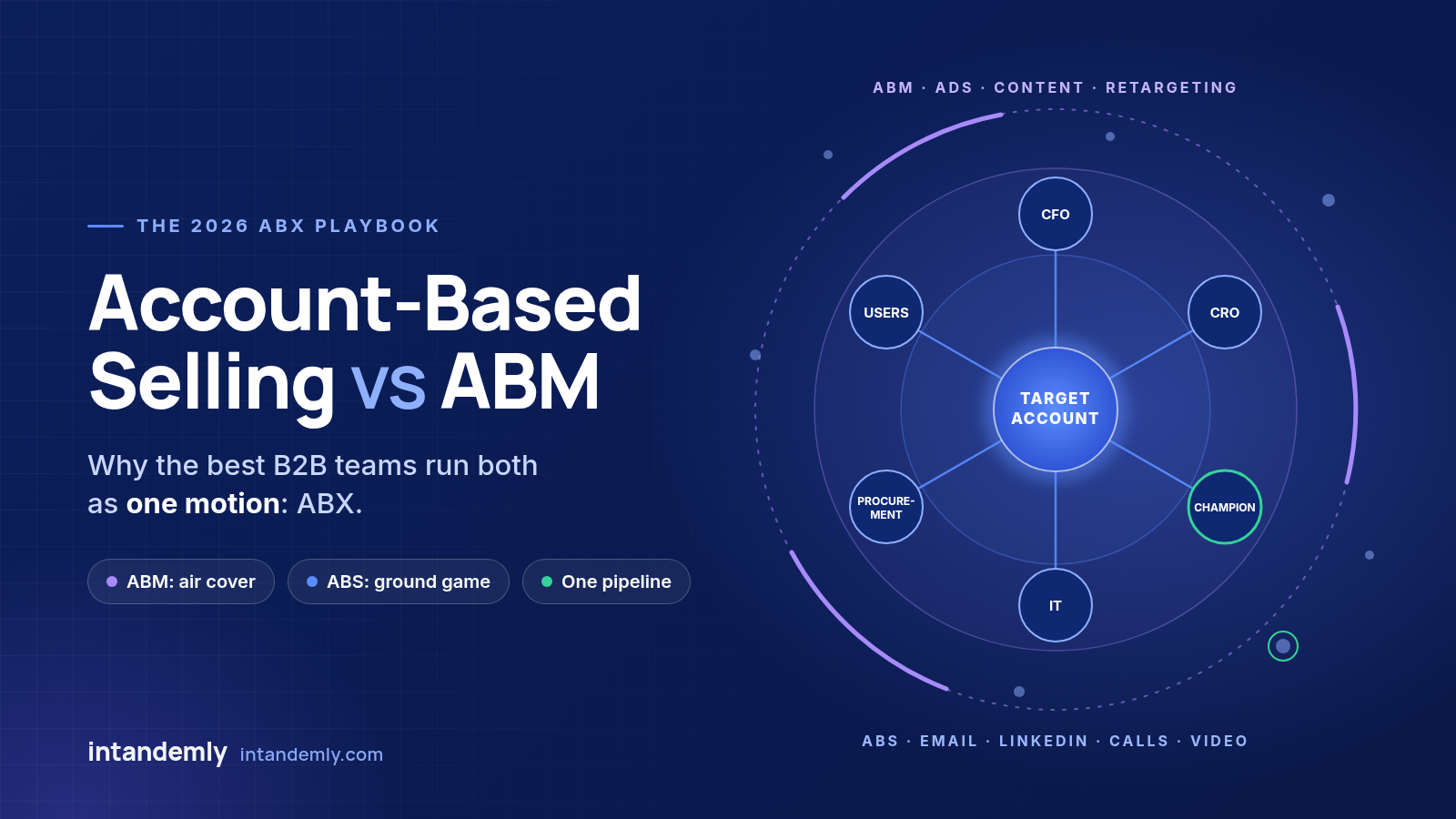
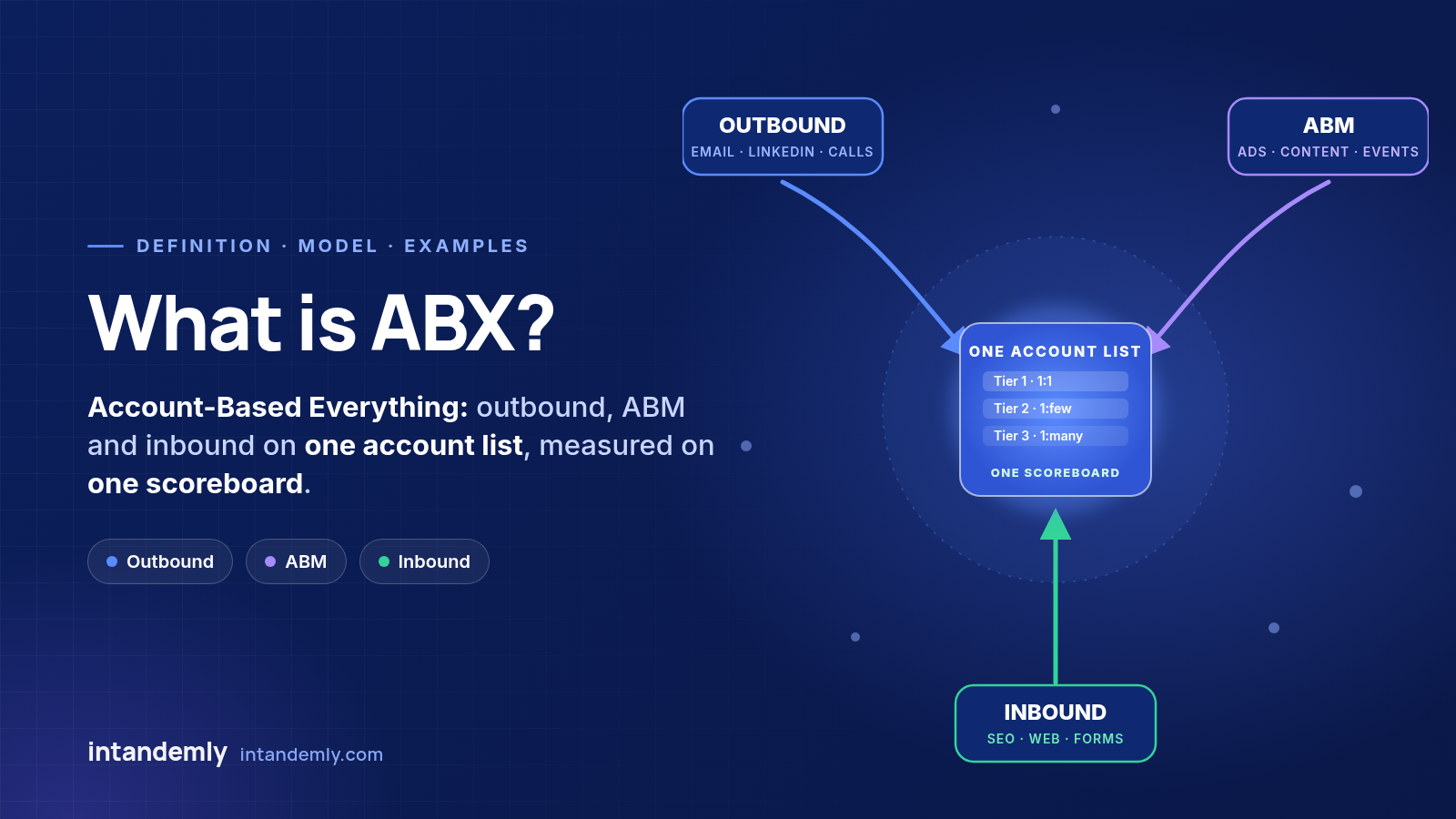
The short answer: account-based marketing (ABM) is the marketing-led motion that makes a named list of target accounts aware of you, interested and warm. Account-based selling (ABS) is the sales-led motion that works those same accounts person by person, across the whole buying group, until the account is open, an opportunity exists and a contract is signed. They aren't competing strategies. They're two halves of one job. The teams winning in 2026 run them as a single motion, which we call ABX (Account-Based Everything): outbound, ABM and inbound pointed at one account list, measured on one scoreboard.
The rest of this guide covers the definitions, a side-by-side comparison, the six-stage INTANDEM framework we use to run both together, copy-and-paste templates, the metrics that matter, and the mistakes that quietly kill most account-based programmes.
Why this question matters more in 2026
Two facts about how B2B buyers now behave explain why "ABM or ABS?" is the wrong question.
1. Buying groups are large, and they get larger when the purchase is complex. Forrester's State of Business Buying, 2026, based on its Buyers' Journey Survey of nearly 18,000 business buyers, reports that on average 13 internal stakeholders and nine external participants influence a buying decision. Buying groups for purchases with genAI features are twice as large (14 members versus seven). (Forrester, Jan 2026)
2. Buyers pick a favourite before they talk to you. 6sense's 2025 Buyer Experience Report surveyed more than 4,000 buyers. It found that 94% of buying groups ranked their preferred vendors before first contact, and they bought from that preliminary favourite 77% of the time. The split between independent research and seller engagement moved from 70/30 to 60/40. (6sense, Nov 2025)
Put those together and the problem is clear:
- Sales alone can't do it. One or two SDRs can't personally warm a 13-person committee before that committee has drawn up its shortlist.
- Marketing alone can't do it either. Ads and content can get you onto the shortlist, but they can't multi-thread a live deal, handle procurement or build a champion.
You need air cover and a ground game, aimed at the same accounts at the same time.
Vendor benchmark data points the same way. Demandbase analysed 1,452 of its customer instances and found that organisations aligning marketing and sales around buying groups achieve up to 2–3× higher win rates than teams built around individual leads. Accounts backed by sustained buying-group-level advertising converted to opportunities at 2–3× the rate of accounts without it. (Demandbase, State of ABM 2026) Treat this as a platform vendor's view of its own customer base, not a neutral census. Still, the direction matches everything we see in the field.
Definitions, without the jargon
What is account-based marketing (ABM)?
Account-based marketing is a B2B strategy where marketing concentrates budget, content and campaigns on a defined list of high-value accounts, instead of generating leads from anyone who turns up. Typical ABM tactics include:
- LinkedIn and programmatic ads targeted at the account list
- Retargeting
- Content tailored to an account or industry
- Events and roundtables
- Personalised landing pages
- Content syndication
The goal is account-level awareness, engagement and intent: the whole buying group knows your name, and the right people are leaning in.
If you're new to ABM, start with our primer, What is account-based marketing?, then the 7-step ABM strategy guide.
What is account-based selling (ABS)?
Account-based selling is the sales-led approach of treating each target account as a single buying unit. Reps research the account, map its buying group and run coordinated, multi-threaded outreach to several stakeholders until the account converts. The tactics are personal and two-way:
- Researched emails
- LinkedIn conversations
- Warm calls
- Video and voice notes
- Referrals from inside the account
- Executive-to-executive outreach
- Tailored business cases and mutual action plans
The goal is account inroads, opportunities and closed revenue from named accounts.
Our guides to building an account-based sales playbook and target account selling (TAS) go deeper on the sales methodology.
What is ABX?
ABX is the operating model that combines the two. You'll see it expanded as account-based experience (the lifecycle-and-customer-experience view) or account-based everything (the "every channel, every team" view). At Intandemly we use Account-Based Everything because it describes what actually has to happen:
- Outbound (ABS): reaches the buying group directly.
- ABM: surrounds the same accounts with relevant air cover.
- Inbound: captures and amplifies the demand the other two create.
All three run from one account list, one set of signals and one pipeline report.
Account-based selling vs account-based marketing: side-by-side
| Dimension | Account-Based Marketing (ABM) | Account-Based Selling (ABS) | ABX (both, as one motion) |
|---|---|---|---|
| Led by | Marketing | Sales (SDRs, AEs, sales leaders) | A joint revenue pod: strategist, SDR, marketer, RevOps |
| Core question | "Does the buying group know us and trust us?" | "Who inside this account will talk to us, champion us and sign?" | "Which accounts are moving, and what's the next best action for each?" |
| Unit of work | Campaign aimed at an account or tier | Conversation with a named stakeholder | The account, and every stakeholder in it |
| Main channels | Paid social, retargeting, content, events, web personalisation | Email, LinkedIn, phone, video/voice notes, referrals | All of the above, sequenced against shared signals |
| Communication style | One-to-many or one-to-few, mostly one-way | One-to-one, two-way | Coordinated: ads prime, reps converse, content proves |
| Scale | Hundreds to thousands of accounts | Tens to hundreds of accounts per rep or pod | Tiered: 1:1 for Tier 1, 1:few for Tier 2, 1:many for Tier 3 |
| Typical KPIs | Account reach, engagement, intent lift, marketing-qualified accounts | Accounts with active conversations, stakeholders engaged, opportunities, win rate, deal size | Pipeline and revenue from target accounts, velocity, CAC |
| Time horizon | Months to build awareness | Weeks to open the first conversation; the sales cycle to close | Continuous: land, then expand |
| Failure mode alone | "Engaged accounts" that never turn into conversations | Cold, single-threaded outreach into buyers who've already shortlisted someone else | Only fails if the list, the data or the handoffs are wrong |
| Best for | Building demand in a defined market; getting on the Day-One shortlist | Converting and expanding high-value, multi-stakeholder deals | Any B2B company selling complex, considered deals to a defined ICP |
Rule of thumb: ABM earns you the right to a conversation. ABS turns that conversation into revenue. ABX makes sure neither is wasted.
When to lean on ABM, when to lean on ABS
You'll almost always need both. The weighting changes with your situation.
Lean ABS-first if:
- You're entering a new market (a new region, vertical or segment) where nobody knows you yet and you need conversations now.
- Your average deal value justifies personalised, human outreach, but your marketing budget is modest.
- Your target universe is a few hundred accounts, not tens of thousands.
- You need to validate your ICP and messaging quickly. Two-way conversations tell you in weeks what campaign data takes quarters to reveal.
Lean ABM-heavier if:
- Your category is crowded and buyers already have shortlists, so you must be known before you reach out.
- Your deals involve large committees (procurement, security, finance, IT, end users) whom reps can't realistically reach one by one.
- You already have a sales team with capacity, and they're burning time on cold accounts.
- You want to expand inside existing customers across divisions or geographies.
Run full ABX when you sell a considered B2B product (think five-figure-plus contract values), your sales cycle runs to months, and you can name the accounts you want to win. For most of the B2B SaaS, fintech, IT services and enterprise-tech companies we work with across India, the US, the UK and the GCC, that describes the business exactly.
The INTANDEM framework: six stages to run ABS and ABM as one motion
Reference version: The INTANDEM framework: stages, owners, exit tests and metrics
We've run account-based programmes since April 2017, almost ten years. The pattern that works has six stages. We call it INTANDEM: everything we do is about getting in to the account, and every stage only works when sales and marketing move in tandem. The six stages spell out T-A-N-D-E-M.
INTANDEM: how we get IN to an enterprise account and work it in TANDEM, sales and marketing as one motion.
| Stage | What happens | Owner | Output |
|---|---|---|---|
| T – Target together | Agree the ICP, build and tier one shared account list | Sales + marketing + RevOps | A single Tier 1/2/3 list in the CRM |
| A – Assemble the buying group | Map roles, people and entry points per account | SDR + data researcher (AI-assisted) | Buying-group map per Tier 1–2 account |
| N – Nurture with air cover | Point ABM ads, content and retargeting at the same list | Marketing | Account-level awareness and intent signals |
| D – Direct, multi-threaded selling | Coordinated outreach to several stakeholders per account | SDR/AE | Replies, conversations, champions |
| E – Escalate on signals | Shared rules for when and how each team acts on account behaviour | Joint (the "revenue pod") | Faster, better-timed follow-up; no dropped handoffs |
| M – Measure and multiply | One scoreboard; reallocate budget to what moves accounts; expand wins | RevOps + leadership | Pipeline, velocity, CAC; expansion plays |
T — Target together
Most account-based programmes fail here, before a single email goes out. If marketing buys ads against one list and sales prospects a different one, you're paying twice to reach nobody properly.
How to do it:
- Write the ICP in firmographic and situational terms. Firmographics cover industry, size, geography and tech stack. Situations are what make an account likely to buy now: new funding, a new CXO, regional expansion, a regulatory deadline, a competitor contract ending.
- Build the account universe (your TAM), then score it. Our ABM account selection criteria guide gives you a scoring model, and account segmentation for ABM shows how to group accounts by need.
- Tier ruthlessly. Tier 1 gets 1:1 treatment (bespoke research, custom content, exec involvement). Tier 2 gets 1:few (industry or use-case clusters). Tier 3 gets 1:many (programmatic personalisation). See ABM account tiering for how to size each tier.
- Load one list into the CRM and sync it to your ad platforms and sequencing tools. One list, one source of truth.
Checklist: Target together
- ICP signed off by the heads of sales and marketing
- Account list scored on fit plus timing signals
- Tiers sized to capacity (don't give 300 accounts "1:1" treatment with one SDR)
- The same list is live in the CRM, the ad audiences and the outreach tool
- Exclusions agreed (current customers, open opportunities, partners, competitors)
A — Assemble the buying group
With 13-odd internal stakeholders involved in a typical decision, "we emailed the VP" is not account coverage. For each Tier 1 and Tier 2 account, map at least these roles:
- Economic buyer: owns the budget (CFO, CRO, business unit head).
- Champion: feels the pain daily and will sell internally for you.
- Technical evaluator: IT, security, data or architecture.
- Users: the team that will live with the product.
- Procurement / legal: Forrester found procurement acts as a decision-maker in 53% of buying cycles (source).
- Blockers / sceptics: whoever is invested in the status quo or a competitor.
For each person, note their likely priorities, recent public activity (posts, talks, hires, company announcements) and an entry point: the specific problem or trigger you'll open with. AI research tools make this fast. Human judgement makes it accurate.
Our step-by-step guide to mapping target accounts walks through the process.
Template: buying-group map (one row per stakeholder)
| Account | Name / title | Role in decision | What they care about | Trigger / entry point | Channel preference | Status |
|---|---|---|---|---|---|---|
| Acme FinCloud | CFO | Economic buyer | Cost-to-serve, audit risk | New regional entity launched | Email + exec intro | Not contacted |
| Acme FinCloud | Head of AP | Champion | Manual invoice volume | Hiring 3 AP clerks (job posts) | LinkedIn + video note | Replied |
| Acme FinCloud | IT Security Lead | Technical evaluator | Data residency | Recent ISO 27001 post | Email with security pack | Not contacted |
(Illustrative example, not a real company.)
N — Nurture with air cover
Now ABM earns its keep. Before and during outreach, the same accounts should keep seeing you in the places they already spend time:
- LinkedIn ads targeted at the account list and buying-group job functions. Thought-leadership posts and proof points work better here than a hard sales ask. Our guide to ABM with LinkedIn Ads covers the setup.
- Retargeting for anyone from a target account who visits your site.
- Content built for the committee, not just the champion: a business case for finance, a security and integration pack for IT, and a peer case study for users.
- Events and roundtables for Tier 1, in-region where it matters. In the GCC in particular, face-to-face credibility still carries enormous weight.
The purpose of air cover is to make sure that when your rep's email lands, it isn't the first time the buyer has seen your name. That's how you get onto the Day-One shortlist that 6sense says buyers build before they contact anyone.
D — Direct, multi-threaded selling
This is account-based selling proper. Stop running a 7-step sequence to one person and start running a coordinated play across the buying group:
- Thread 3–5 stakeholders per Tier 1 account at once, each with a role-specific angle. The CFO hears about risk and cost, the champion hears about workload, IT hears about security.
- Mix channels: email, LinkedIn, warm calls, and personalised video or voice notes. In Intandemly programmes a Tier 1 account is planned at 10 to 14 touches across up to six channels. That's a planning norm from our own work, not an industry statistic. Our multi-channel prospecting guide covers the cadence mechanics.
- Reference the air cover. "You may have seen our note on AP automation for multi-entity groups…" converts better when it's true.
- Go top-down where it fits. Senior-to-senior outreach unlocks accounts that bottom-up never will. See C-suite selling.
Template: a multi-threaded Tier 1 week (adapt to your cadence)
| Day | Champion | Economic buyer | Technical evaluator |
|---|---|---|---|
| Mon | LinkedIn connect with a note referencing their team's hiring | — | — |
| Tue | Email 1: problem-led, 90 words, one question | Email 1: outcome-led, 3 lines, peer proof | — |
| Wed | — | — | Email 1: security/integration angle + one-pager |
| Thu | 45-second personalised video note | LinkedIn: comment on their recent post (genuinely) | — |
| Fri | Warm call | — | LinkedIn connect |
| Always on | ABM ads + retargeting to the whole account | ← same | ← same |
Template: first-touch email to an economic buyer
Subject: {Company}'s {trigger}: one question
Hi {First name},
Congratulations on {specific trigger, e.g. launching the Riyadh entity}. When finance teams at {peer type} add a new entity, {specific pain} usually lands on {role} first.
We helped {relevant client or peer type} {concrete, verifiable outcome}.
Worth a 20-minute look at how that would apply to {Company}? If it isn't a priority this quarter, just say so and I'll leave it there.
{Name}
Every variable must be real. If you can't fill {specific trigger} with something true about that account, it isn't Tier 1 yet.
E — Escalate on signals
This stage turns two motions into one. Agree written rules of engagement for what happens when an account shows behaviour:
| Signal | What it means | Marketing action | Sales action | SLA |
|---|---|---|---|---|
| 3+ people from one account engage with ads or content in 14 days | Buying group is warming | Increase frequency; serve proof content | Start or accelerate a multi-threaded play | 48 hours |
| Pricing, comparison or case-study page visit from a target account | Active evaluation | Retarget with proof and business-case content | Personal outreach referencing the relevant use case | 24 hours |
| A new senior hire in a relevant function | Priorities being reset | Add to audience | Congratulate and give a point of view (not a pitch) | 1 week |
| Positive reply from any stakeholder | Door is open | Suppress generic ads; serve account-specific content | Agree the next conversation; ask who else should join | Same day |
| First conversation held, opportunity created | Deal in motion | Air cover for the wider committee (security, finance content) | Mutual action plan; thread procurement early | Ongoing |
| Deal lost or stalled | Timing or fit issue | Move to long-term nurture | Log the reason; set a re-engagement trigger | — |
Write it down, put it in the CRM as tasks and alerts, and review it in a weekly pipeline review. If there's no SLA, the handoff isn't really happening.
M — Measure and multiply
Measure accounts, not leads (full metric list below). Every month, ask:
- Which tiers, segments and messages are moving accounts forward?
- Where are engaged accounts stalling?
Move budget and SDR time towards what's working. Then multiply: every account you win is a land. Run the same INTANDEM play into its other divisions, regions and buying groups.
What this looks like in practice: three Intandemly programmes
These figures come from Intandemly's published client case studies. Each funnel ends in accounts penetrated, not in messages sent.
BEST SAP: SAP finance add-ons, MENA and APAC. The programme was aimed at finance leaders inside named accounts, over LinkedIn and email. The funnel reads: 1,500 connections, 800 accounts reached, 30 positive responses and 22 accounts penetrated. Read the BEST SAP case study →
Bankai Infotech: telecom software, India and MENA. The funnel reads: 1,985 connections, 818 accounts reached and 21 accounts penetrated. Read the Bankai Infotech case study →
Yango Tech: e-grocery technology. The October 2023 funnel reads: 714 accounts reached, 36 positive responses and 12 accounts penetrated. Read the Yango Tech case study →
The common thread: none of these was "just ABM" or "just outbound". Each started from one account list and researched buying groups, and each was counted in accounts opened, not in activity.
The metrics that matter (and the ones that don't)
Account-based programmes fail the ROI conversation when they report the wrong things. Forget sends, opens and MQL counts. Track four layers:
1. Coverage (are we in the right accounts, with the right people?)
- % of target accounts with a mapped buying group
- Average stakeholders engaged per Tier 1 / Tier 2 account (aim for multiple, not one)
- % of target accounts reached by both ads and direct outreach
2. Engagement (is the account leaning in?)
- Account engagement rate: accounts with 2+ engaged stakeholders ÷ total target accounts
- Positive reply rate by tier and persona
- Intent or website-visit lift in target accounts versus a holdout group
3. Conversion (is it turning into pipeline?)
- Target accounts with an active two-way conversation (and how many of them reach a second stakeholder)
- Engaged account → opportunity conversion rate
- Pipeline value created from target accounts, by tier
4. Revenue and efficiency (is it worth it?)
- Win rate on target accounts versus non-target deals
- Average deal size on target accounts versus baseline
- Sales cycle length (velocity)
- Customer acquisition cost and payback
- Expansion revenue from won accounts
A simple scoreboard to share with the board each month:
| Metric | Tier 1 | Tier 2 | Tier 3 | Non-target baseline |
|---|---|---|---|---|
| Accounts in tier | — | |||
| % with 3+ stakeholders engaged | — | |||
| Accounts with active conversations | ||||
| Opportunities created | ||||
| Pipeline created | ||||
| Win rate | ||||
| Avg deal size | ||||
| Avg cycle length (days) |
The comparison against the non-target baseline is what proves the programme is working. Without it, you're only reporting activity.
Seven mistakes that sink account-based programmes
- Two lists, two teams, two scoreboards. Marketing optimises for engagement and sales optimises for closed deals, on different accounts. Fix it at stage T.
- Single-threading. One contact per account is a single point of failure. They leave, go quiet or lack authority, and the deal dies. Map and thread the buying group.
- Calling a mail merge "personalisation".
{FirstName}and{Company}aren't account-based anything. Personalise to the account's situation (trigger, strategy, pain), then to the person's role. - Too many Tier 1 accounts. If everything is 1:1, nothing is. Size tiers to real research and SDR capacity.
- ABM without follow-through. Ads create warm accounts that nobody calls. Warm accounts cool fast. Stage E exists to stop this.
- Outbound without air cover. Reps cold-contact buying groups who've already ranked their vendors. You end up competing for second place.
- Judging it in 30 days. Account-based motions compound. Judge early on leading indicators (coverage, engagement, active conversations) and on pipeline and revenue over a full cycle. That's why most serious programmes, including ours, run for at least a quarter or two.
Your 90-day ABX launch checklist
Days 1–30: Foundation
- ICP and account universe defined; accounts scored and tiered
- One target list synced across CRM, ads and outreach tools
- Buying groups mapped for all Tier 1 and priority Tier 2 accounts
- Messaging matrix by persona × use case × region
- Email infrastructure and deliverability set up (see why emails go to spam)
- Rules of engagement and SLAs agreed and written down
Days 31–60: Go live
- ABM ads and retargeting live against the list
- Multi-threaded outreach live for Tier 1 and Tier 2; 1:many plays for Tier 3
- Weekly joint pipeline review started
- Early message testing: which angles earn positive replies, by persona
Days 61–90: Optimise and scale
- Shift budget and SDR time towards the best-converting segments
- Add committee content (business case, security pack, peer proof)
- First tier-level scoreboard against the non-target baseline
- Plan expansion plays for early wins
How AI changes ABS and ABM in 2026 (and what it doesn't)
AI has made the research part of account-based work dramatically cheaper. It can:
- Summarise an account's annual report
- Spot trigger events
- Draft a buying-group map
- Suggest role-specific angles in minutes
Buyers use it too. Forrester reports that 94% of business buyers use AI during their buying process, but they increasingly validate what it tells them with peers, experts and analysts (Forrester).
What AI doesn't do is earn trust. Three rules we follow:
- AI for research and timing, humans for judgement and voice. Use models to find the signal and draft the brief. A strategist decides whether the account really is a priority and what to say.
- Proof beats polish. When every vendor can generate fluent copy, specific, verifiable outcomes and credible peers are what separate you.
- Be answer-ready. Buyers ask AI assistants for shortlists and comparisons. Clear, factual content about what you do, for whom and with what results (like this page) is now part of your ABM air cover.
Frequently asked questions
What is the difference between account-based selling and account-based marketing?
Account-based marketing is marketing-led: campaigns, ads and content that make a defined list of target accounts aware of you and interested. Account-based selling is sales-led: researched, multi-threaded, one-to-one outreach to the stakeholders inside those accounts to open conversations and close deals. ABM earns the conversation. ABS converts it.
Is account-based selling the same as target account selling?
They're closely related. Target account selling (TAS) is an established sales methodology for planning and winning specific strategic accounts. Account-based selling is the broader modern practice of treating each target account as one buying unit, and it usually runs alongside ABM. See our target account selling guide.
Do I need ABM if I already do outbound?
Usually, yes, if your deals involve several decision-makers. Buyers typically rank a preferred vendor before first contact, so outbound without air cover often competes for second place. Adding ABM ads, retargeting and committee content to the same account list makes your outreach land warm.
What is ABX (Account-Based Everything)?
ABX is an operating model that runs outbound (account-based selling), ABM and inbound as one coordinated motion against a single target account list, with shared signals and one pipeline scoreboard. Some use "ABX" to mean account-based experience. Either way, the idea is to stop running disconnected channel programmes.
How many accounts should an account-based programme target?
Match the number to your capacity and tiers. Tier 1 (1:1) is usually a small number of accounts per strategist or SDR. Tier 2 (1:few) can run to hundreds. Tier 3 (1:many) to thousands. A list the team cannot research properly is too long, whatever the tier.
How do you measure account-based marketing and selling?
Measure at account level across four layers: coverage (buying groups mapped and engaged), engagement (accounts with multiple engaged stakeholders), conversion (active conversations, opportunities and pipeline from target accounts) and revenue (win rate, deal size, cycle length and CAC compared with non-target deals).
How long does account-based selling take to show results?
Leading indicators such as replies, engaged stakeholders and first conversations typically show within the first few weeks of outreach. Pipeline and revenue take a full sales cycle to judge properly, which is why most programmes run for at least one to two quarters before they're evaluated.
Is ABM only for large enterprises?
No. ABM and account-based selling suit any B2B company that sells considered deals to a definable set of accounts, including start-ups and SMBs. The difference is scale: smaller teams run fewer Tier 1 accounts and lean more on outbound. See Is ABM right for small businesses?
Related reading: What is ABX (Account-Based Everything)? Definition, model and examples
The bottom line
"Account-based selling vs account-based marketing" is a useful distinction for org charts and a poor one for strategy. Buyers don't experience your programmes separately. They see one company showing up (or not) across their whole buying group. The winners in 2026:
- pick their accounts together
- map the full committee
- warm it with air cover
- work it with multi-threaded, human outreach
- act on signals within hours
- measure everything in pipeline and revenue
That's ABX. The selling half of it is what Intandemly does: we are an account-based selling company, and have been since April 2017.
Want this run on your key accounts? Tell us which accounts you need to open, and we will show you how we would work them: the list, the buying groups and the first conversations in each. Talk to us. To practise the method first, the free Account Scoring Tool and Buying Committee Map are in the Intandemly Academy.
Name the accounts you need to win.
Our platform plus a dedicated consultant who works only your key accounts, until you're inside them.