ABM Agency vs In-House Team vs ABM Platform: Cost and Trade-offs
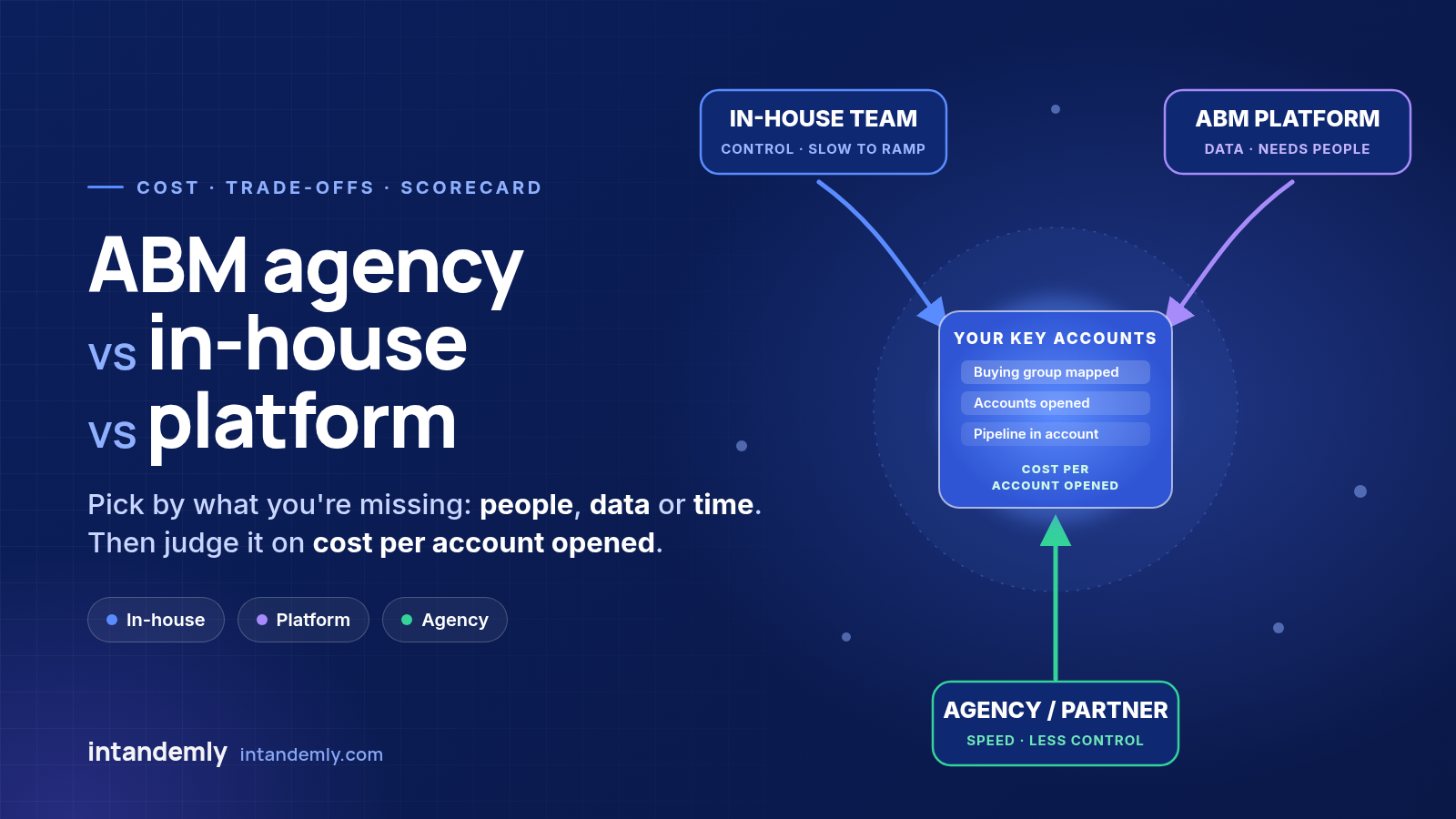
Choose by what you're missing. An in-house team gives you control and knowledge that compounds, but takes months to hire and ramp. An ABM platform gives you data and orchestration, but nobody to do the selling. An agency gives you speed and a ready-made team, but less control. Many B2B companies end up with a mix of the three.
Key takeaways
- In-house = control. You own the knowledge, but you pay for hiring, a ramp of about three months per rep and turnover.
- Platform = data. Median contracts for 6sense and Demandbase run about $62,000 to $69,000 a year before implementation, and the software still needs people to run it.
- Agency = speed. You rent a working team and playbook. Quality varies hugely, because "ABM agency" covers everything from ad management to full account-based selling.
- Compare cost per key account opened, not the monthly fee.
- Many teams land on a hybrid: a partner or platform for speed now, in-house ownership later.
Last updated: 8 October 2026. Costs below were checked against their sources on this date.
A note on bias: Intandemly is a specialist account-based selling company, so we have a stake here. This comparison includes when you shouldn't hire anyone like us.
What's the real difference between an ABM agency, an in-house team and an ABM platform?
All three aim at the same job: getting inside a short list of high-value accounts, across the whole buying group, until there's pipeline. They differ in who does the work and what you're buying.
| In-house team | ABM platform | ABM agency or partner | |
|---|---|---|---|
| What you buy | People you hire and manage | Software: intent data, account insights, ad orchestration | An outside team, its playbook and its infrastructure |
| Who does the work | Your staff | Your staff, using the software | The agency, working with your sales team |
| Main strength | Control and knowledge that compounds over time | Visibility across thousands of accounts | Speed to launch and experience from other programmes |
| Main weakness | Slow to hire and ramp, turnover risk | Doesn't sell anything by itself | Less control, and quality varies widely |
| Cost shape | Salaries, management, tools, attrition | Annual licence plus implementation | Monthly retainer, usually plus media |
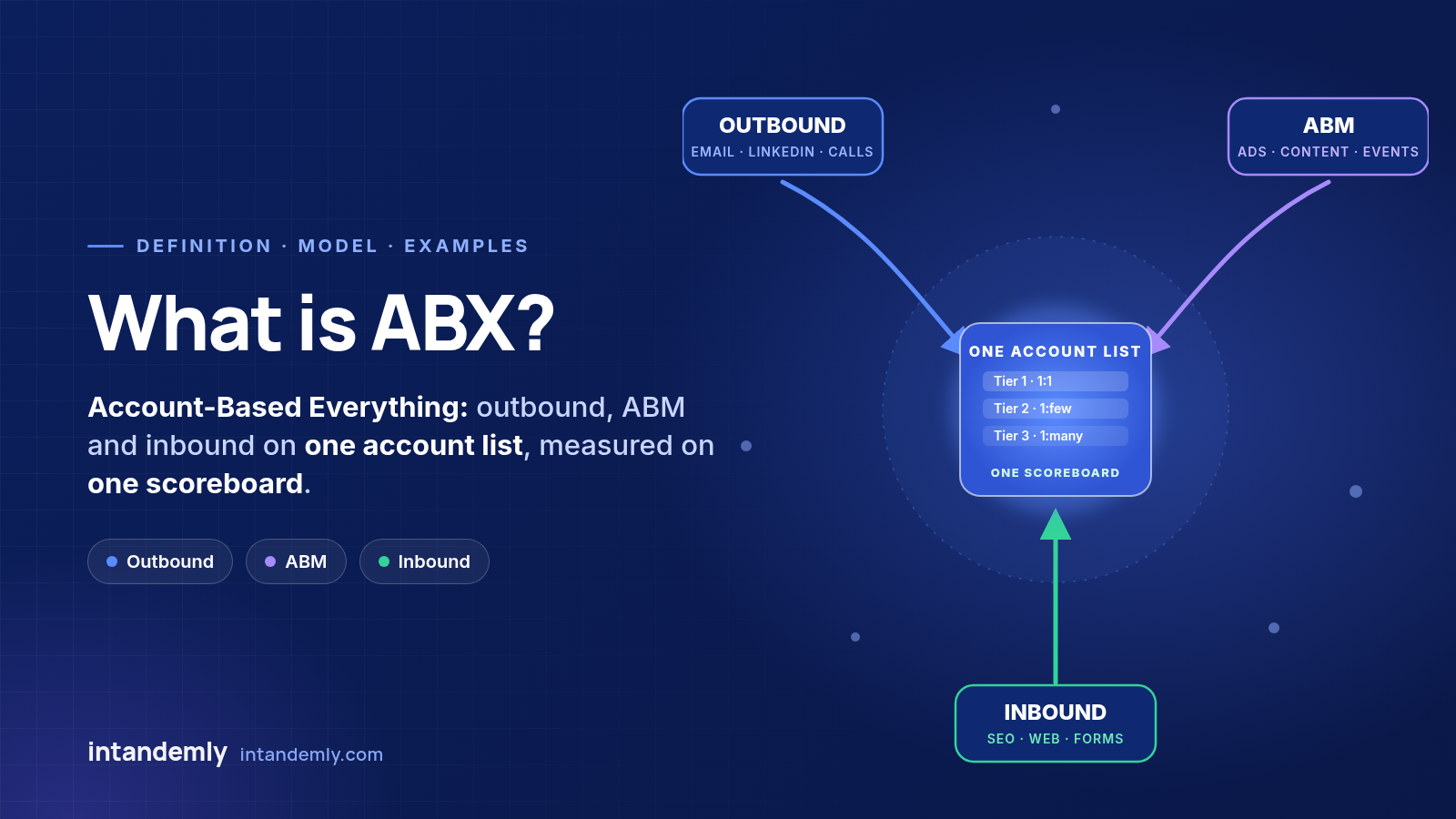
This isn't really a software or hiring decision. It's an operating-model decision: who owns the account list, maps the buying group, reaches out and keeps score. Our guide to ABX (Account-Based Everything) covers that model.
How much does each option cost?
Most vendors and agencies don't publish prices. Below are the figures we could verify from their sources on 8 October 2026; where none exist, we compare cost components instead.
What does an in-house ABM team cost?
The best public benchmark for outbound sales talent is The Bridge Group's 2025 SDR research, based on 351 B2B companies (78% based in North America). It reports:
- Median SDR on-target earnings of $80,000 ($55,000 base, $25,000 variable)
- An average ramp of 3.0 months before a new SDR is productive
- An average tenure of 1.9 years, with a median annual attrition of 40%
- A median SDR manager OTE of $146,000, with about 6.4 SDRs per first-line leader
In India the salary line is far lower. AmbitionBox puts the average Sales Development Representative salary at ₹8.7 lakh a year, based on about 2,500 salaries (updated 8 October 2026).
The payslip is only part of the bill. An in-house team also needs:
- Prospecting tools. LinkedIn lists Sales Navigator Core at US$1,079.88 per licence per year on annual billing.
- Contact and company data. Vendr's transaction data puts the median ZoomInfo contract at $33,500 a year, across 1,576 purchases.
- Email infrastructure and deliverability work (see our guide to keeping emails out of spam).
- Account research, messaging, content and paid media for air cover.
- Someone who has run an account-based programme before. Most teams skip this line, and it decides whether the rest works.
An illustrative first year: two US SDRs at the median OTE cost $160,000. Add two Sales Navigator Core licences (about $2,160) and a median ZoomInfo contract ($33,500), and you're at about $196,000. That's before a manager, benefits, payroll taxes, content, ads or an ABM platform. With a three-month ramp, the first quarter is mostly spent getting ready, and with tenure under two years, plan to hire and ramp again.
What does an ABM platform cost?
ABM platforms rarely publish list prices. Vendr's anonymised purchase data, checked on 8 October 2026, shows:
| Platform | Median annual contract | Purchases in sample | Source |
|---|---|---|---|
| 6sense | $62,220 | 386 | Vendr: 6sense |
| Demandbase | $68,591 | 187 | Vendr: Demandbase |
These medians move as Vendr adds deals, so treat them as a starting point, not a quote. Nor is the licence the full cost. Vendr says 6sense implementation is usually billed separately, at $10,000 to $50,000+ depending on complexity. For Demandbase, it says onboarding, professional services and advertising media can add 20–40% to first-year cost.
The bigger hidden cost is people. A platform shows which accounts are showing intent and targets ads at them. It doesn't research the buying group, write the message or follow up. Demandbase's own State of ABM 2026 benchmark says a typical buying group has 13–17 stakeholders, and that organisations aligned around buying groups achieve up to 2–3× higher win rates than teams centred on individual contacts. Reaching 13 people inside each key account is human work. A licence doesn't do it.
If you've already decided software is the answer, our guide to choosing the right account-based sales platform covers which features to compare.
What does an ABM agency cost?
Agencies publish prices even less often than platforms. One US ABM agency that does, Gigawatt Group, lists:
- Pilot programmes: $5,000–$15,000 a month
- Mid-scale (1:few) programmes: $15,000–$40,000 a month
- Enterprise 1:1 programmes: $40,000–$120,000+ a month
That's one agency's published range, not a market average. Pricing varies by region, scope and number of accounts, and media is usually extra. Because "ABM agency" covers very different businesses (see below), two quotes for "ABM" can describe two different services.
What are the cost components, side by side?
| Cost component | In-house team | ABM platform | Agency or partner |
|---|---|---|---|
| People | Salaries, variable pay, benefits, a manager | Your team still runs it | Included in the fee |
| Hiring and ramp | Recruiting time plus about 3 months' ramp per rep | Learning the tool | Mostly absorbed by the agency |
| Attrition | About 40% a year (median), then re-hire and re-ramp | None, but the licence renews whether it's used or not | The agency's problem, if the contract says so |
| Data and tools | Paid by you | Partly included (intent, account data) | Often included, so check |
| Licence and implementation | Optional | Annual contract plus a one-off setup fee | Usually none, or a platform the agency provides |
| Paid media | Paid by you | Paid by you, often on top of the licence | Usually paid by you, separately from the fee |
| Strategy and playbook | Built from scratch, or hired in | Vendor guidance only | Arrives with the team |
| Cost to exit | Severance and lost knowledge | Contract term, usually annual | Notice period; make sure you own the data |
The number to compare is cost per key account opened: total spend divided by the number of target accounts where you've built a real relationship inside the buying group. A cheaper monthly fee that opens no accounts is the most expensive option on the table.
What are the trade-offs beyond cost?
| In-house team | ABM platform | Agency or partner | |
|---|---|---|---|
| Speed to first outreach | Slowest: hire, then ramp | Medium: implementation and data set-up | Fastest, if the playbook and infrastructure already exist |
| Control of messaging and brand | Full | Full | Shared: insist on approving messaging |
| Knowledge retention | Stays with you, until people leave | The data stays; the know-how doesn't | Leaves with the agency unless you own the account maps and playbook |
| Buying-group coverage | Limited by headcount | Shows who's active, but doesn't reach them | Depends on how many accounts each consultant carries |
| Flexibility | Hard to scale down | Locked in for the contract term | Easiest to scale up, down or into a new region |
| Biggest risk | Hiring the wrong first person | Shelfware: a licence nobody uses | A lead-gen shop wearing an ABM label |
When is an in-house team the better choice?
Build in-house when account-based selling is a permanent, core capability and you can afford to learn it properly:
- You already have someone who has run an account-based programme before, and can lead it.
- Your product is technical or your deals are long enough that the knowledge built up per account is a competitive advantage.
- You can give a new team two or more quarters to ramp before judging it on pipeline.
- Your volume of key accounts justifies at least two or three dedicated people, plus a manager.
Hire the leader first, then the team. Don't hire three SDRs and hope a strategy emerges.
When is an ABM platform the better choice?
Buy a platform when people aren't your constraint but visibility is:
- You already have SDRs, AEs and marketers with capacity, but they don't know which accounts to work or when.
- Your target universe runs to thousands of accounts, too many to research by hand.
- You run, or plan to run, account-targeted advertising at meaningful scale.
- You have RevOps support to integrate the CRM and marketing automation and keep the data clean.
A platform multiplies a team that already works. It can't create sales and marketing alignment, and it won't reach out on its own.
When is an agency or specialist partner the better choice?
Bring in a partner when time or expertise is the constraint:
- You need inroads into key accounts this quarter, not after a two-quarter hiring cycle.
- Nobody in-house has run account-based selling, and you'd rather not learn on your best accounts.
- You're entering a new region where you have no network or local playbook, for example moving from India into the UAE and Saudi Arabia.
- You want to prove what works before committing to headcount.
- You need depth inside a focused list of named accounts, not reach.
What that looks like in practice, from Intandemly's published case studies:
- Lyxel & Flamingo (L&F MENA): 1,200+ accounts targeted and 37 qualified enterprise inroads in Q3 2024, across the UAE, Saudi Arabia and the wider GCC and MENA region.
- Viacon: 780 premium accounts targeted in India and 22 qualified inroads, with named conversations at brands including PMJ Jewellers and Epigamia.
- RightChoice.ai: 9+ enterprise accounts engaged and 4 high-intent deals in pipeline since 15 December 2025, across multi-location brands in the GCC and MENA.
Are all ABM agencies the same?
No, and this is where most buying decisions go wrong. Three different businesses use the label:
| Type | What they actually do | Judged on | Good for |
|---|---|---|---|
| Paid-media ABM agency | Runs account-targeted ads, often on LinkedIn or an ABM platform | Reach, engagement, cost per click | Air cover, when you already have a sales team to follow up |
| Outbound lead-gen agency | Sends email sequences at a contact list | Replies and volume | Testing a new market quickly with broad lists |
| Specialist account-based selling partner | Maps the buying group in each key account and works it across outbound, ABM and inbound | Accounts opened, buying-group coverage, pipeline in target accounts | Breaking into, and expanding within, high-value named accounts |
Intandemly is the third type: our platform plus a dedicated consultant who works only your key accounts. Your consultant is dedicated to you alone, and you see every account, stakeholder and touchpoint live in the Intandemly platform. We run each account through our six-stage INTANDEM framework.
Whichever type you consider, ask three questions before you sign:
- Who exactly works my accounts, and how many other clients do they serve?
- Do you report activity, or accounts opened and buying-group coverage?
- Do I own the account maps, data and messaging if we stop?
What about hybrid models?
Many mature teams combine the options:
| Hybrid | How it works | Watch out for |
|---|---|---|
| Platform + in-house team | Your team works the accounts the platform shows are in-market | Shelfware if no one owns the weekly signal review |
| Partner opens, your AEs close | The partner gets inside the account and maps the buying group; your account executives run the deal | A clean, fast hand-off and one shared account list |
| Partner first, build later | A partner proves which accounts and messages work, then you hire into a running playbook | Make sure you own the playbook and data from day one |
| In-house core + partner for a new region | Your team covers home markets; a partner opens a new geography such as the GCC | Consistent messaging and a single scoreboard across both |
The common thread is the ABX model: one account list, one set of signals, one scoreboard, however many parties do the work.
How do you decide? A build, buy or partner scorecard
Answer honestly, then tally where your "yes" answers point.
| # | Question | If yes, lean towards |
|---|---|---|
| 1 | Do you already have a leader who has run an account-based programme? | In-house |
| 2 | Do you need inroads into key accounts within the next quarter? | Partner |
| 3 | Do you have SDRs and AEs with spare capacity but poor account visibility? | Platform |
| 4 | Is your target universe in the thousands of accounts, and do you plan to run account-based ads? | Platform |
| 5 | Are you entering a region where you have no network or local playbook? | Partner |
| 6 | Is account-based selling a permanent capability you want to own within two years? | In-house (possibly partner first) |
| 7 | Do you have RevOps capacity to integrate and maintain a platform? | Platform |
| 8 | Would you rather test accounts and messaging before committing to headcount? | Partner |
Reading your score: a clear winner means start there; a split usually means a hybrid. If sales and marketing can't yet agree a named-account list, fix that first. No option works without it. Our guides to ABM strategy and ABM account tiering will help.
What should you measure, whoever runs it?
The same scoreboard works for all three options, which makes it the fairest way to compare them:
| Metric | What it tells you |
|---|---|
| Buying-group coverage | Share of each key account's buying group you've mapped and reached |
| Accounts engaged | Key accounts showing two-way engagement on any channel |
| Accounts opened (account inroads) | Key accounts where you have a real relationship inside the buying group |
| Pipeline in target accounts | Opportunity value created inside the named list |
| Account penetration | Number of buying-group members and business units engaged per opened account |
| Cost per account opened | Total spend ÷ accounts opened, the number that makes the three options comparable |
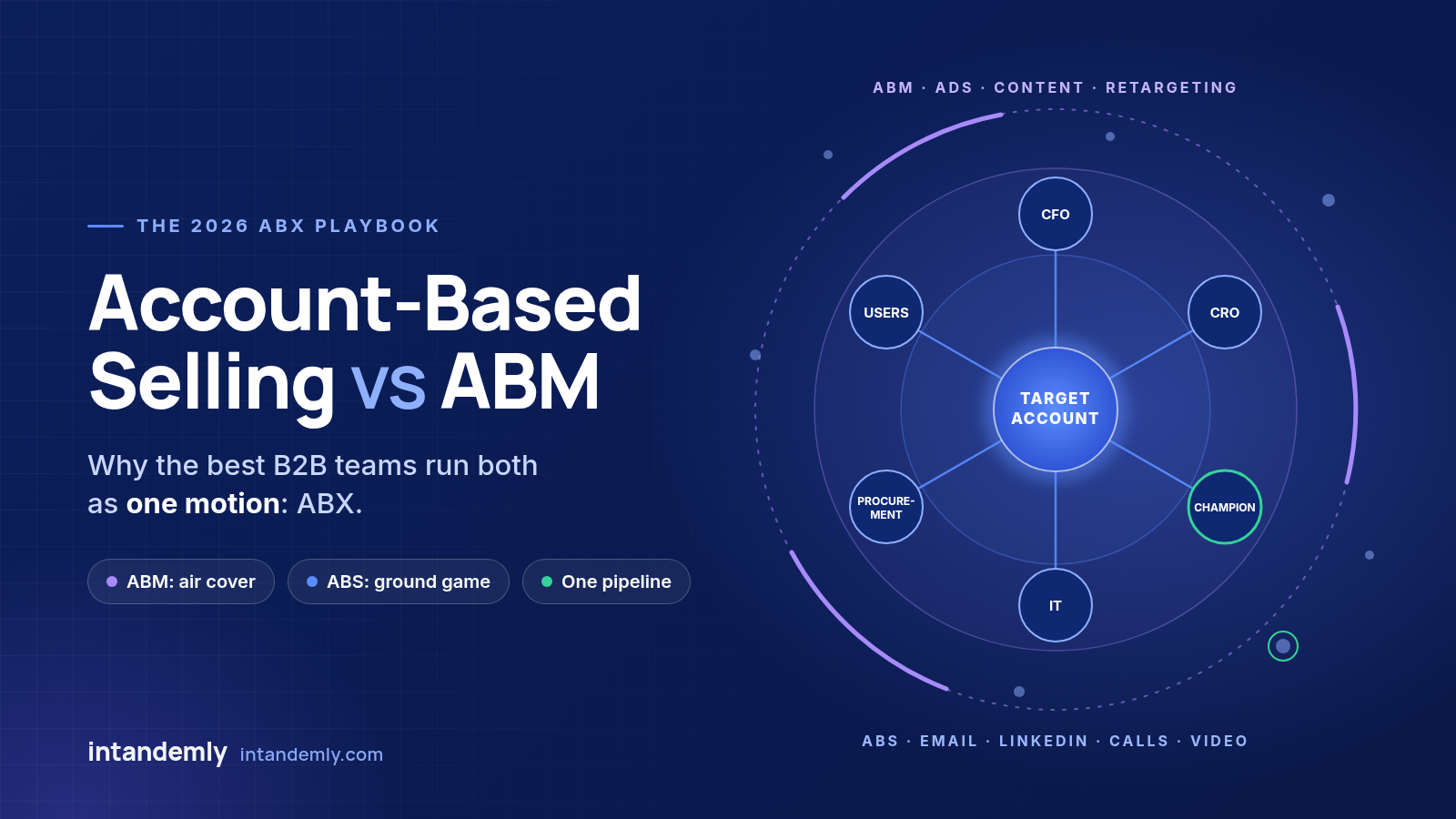
Open rates, clicks and activity counts are diagnostics, not goals. Our ABS vs ABM playbook goes deeper on which metrics matter.
Frequently asked questions
Is an ABM agency cheaper than an in-house team?
Often in year one, not always over time. An agency avoids hiring time, a ramp of about three months per rep and turnover, and brings tools and a playbook. A ramped, stable in-house team can cost less per account. Compare cost per key account opened, not monthly fees.
How much does an ABM platform cost?
ABM platforms rarely publish prices. Vendr's purchase data, checked in October 2026, shows median annual contracts of about $62,000 for 6sense and $69,000 for Demandbase. Implementation, onboarding and media usually cost extra, and you still need people to run the platform and work the accounts.
When should you build an in-house ABM team?
Build in-house when account-based selling is a permanent core capability, you can hire an experienced leader first, your key-account list is stable for years and you can give the team two or more quarters to ramp. Many companies start with a partner and hire once the playbook is proven.
Can an ABM platform replace an agency or an in-house team?
No. A platform provides account data, intent signals and ad orchestration, but it doesn't research buying groups, write messaging or reach out to people. It multiplies a team that already works; it doesn't replace it.
What is the difference between an ABM agency and a lead generation agency?
A lead generation agency sends outreach to a contact list and is judged on replies and volume. A specialist account-based agency works a named list of accounts, maps each buying group and is judged on accounts opened, buying-group coverage and pipeline inside those accounts.
Can you combine an agency, an in-house team and a platform?
Yes, and many mature teams do. Common hybrids are a partner opening accounts while your account executives close, or a platform guiding an in-house team. The rule is one shared account list, one set of signals and one scoreboard across everyone.
How long does an ABM agency take to show results?
Expect early indicators such as buying-group coverage and accounts engaged within the first quarter. Judge accounts opened and pipeline over two or more quarters, because B2B buying cycles are long. Agree the scoreboard and timeline before the programme starts.
What should an ABM agency report on?
Reporting should show which key accounts are mapped, engaged and opened, how much of each buying group has been reached and the pipeline created inside the named list. Activity counts such as emails sent are diagnostics, not results.
The bottom line
There's no universal answer, only the right one for what you're missing. Missing people? Partner or hire. Missing data? Buy a platform. Missing time? Partner. Whichever you choose, judge it on one number: cost per key account opened.
Want to see what a dedicated account-based selling partner would do with your key accounts? In 30 minutes, a senior Intandemly strategist reviews your target accounts and maps a sample buying committee with you. Map my target accounts →