What Is ABM in Marketing? A Plain-English Definition for Named Accounts
ABM in marketing stands for account-based marketing: a B2B approach in which marketing and sales choose a list of named companies first, then aim advertising, content and events at the people who decide inside those companies. It replaces "attract many leads and filter them" with "pick the accounts and earn their attention". ABM warms the account. Account-based selling opens it.
Updated 11 Oct 2026.
What does ABM stand for in marketing?
ABM stands for account-based marketing. "Account" is the B2B word for a company you sell to or want to sell to. If you searched "abm full form" and found a facilities company, a college or Apple Business Manager, those are different things that share the letters. In sales and marketing, ABM means account-based marketing.
Traditional B2B marketing counts leads: individuals who filled in a form. ABM counts accounts: companies, each with several people who must agree before anything is bought.
How does ABM work, step by step?
ABM works in five steps, and the first three involve no campaigns at all.
- Agree the list. Sales and marketing choose the target accounts together, using fit (industry, size, region, technology) and timing (a new leader, an expansion, a contract ending).
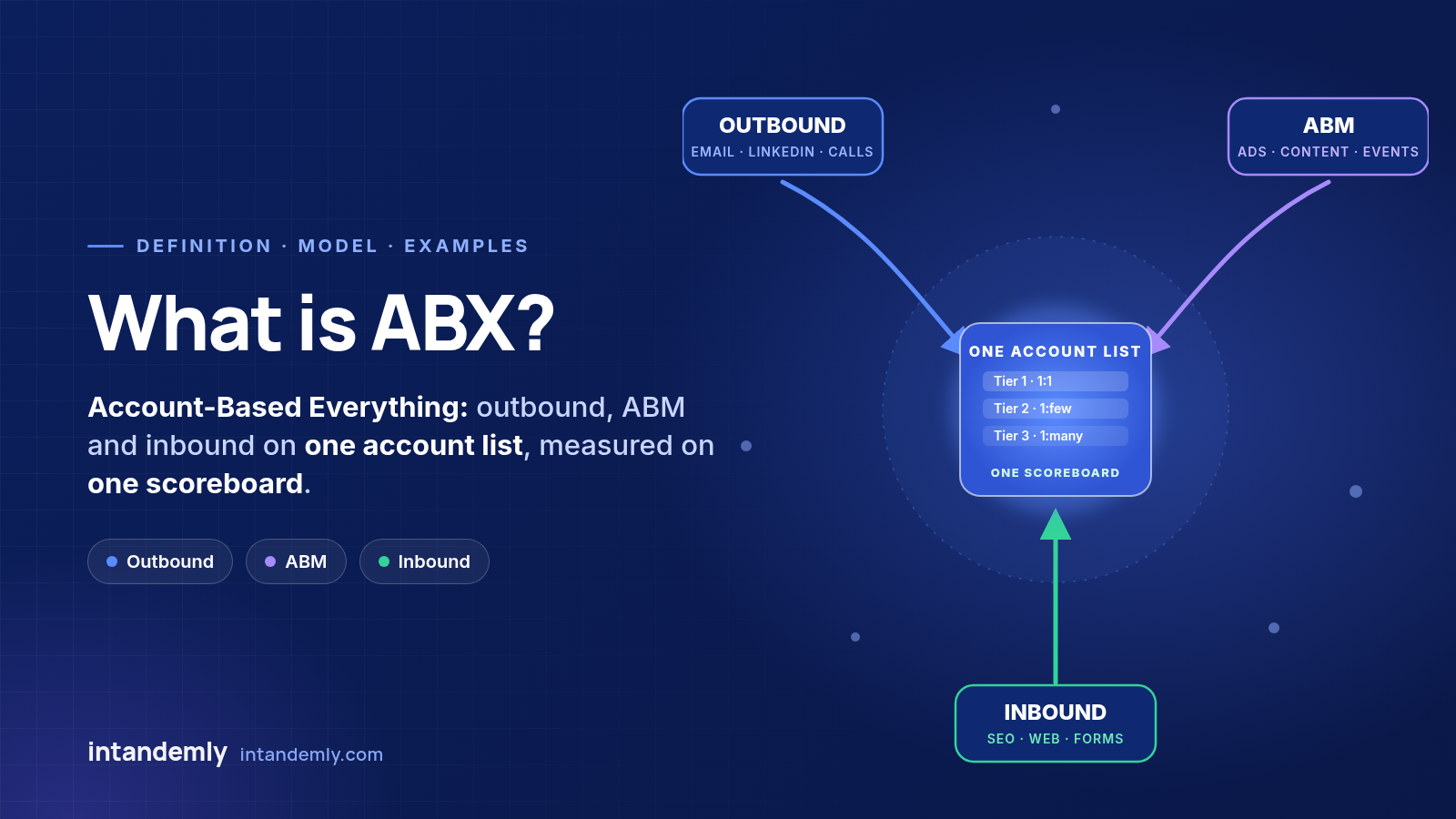
- Tier it. Tier 1 is a small number of accounts that each get individual treatment. Tier 2 is groups of accounts with a shared problem. Tier 3 is a wider set reached with lighter effort.
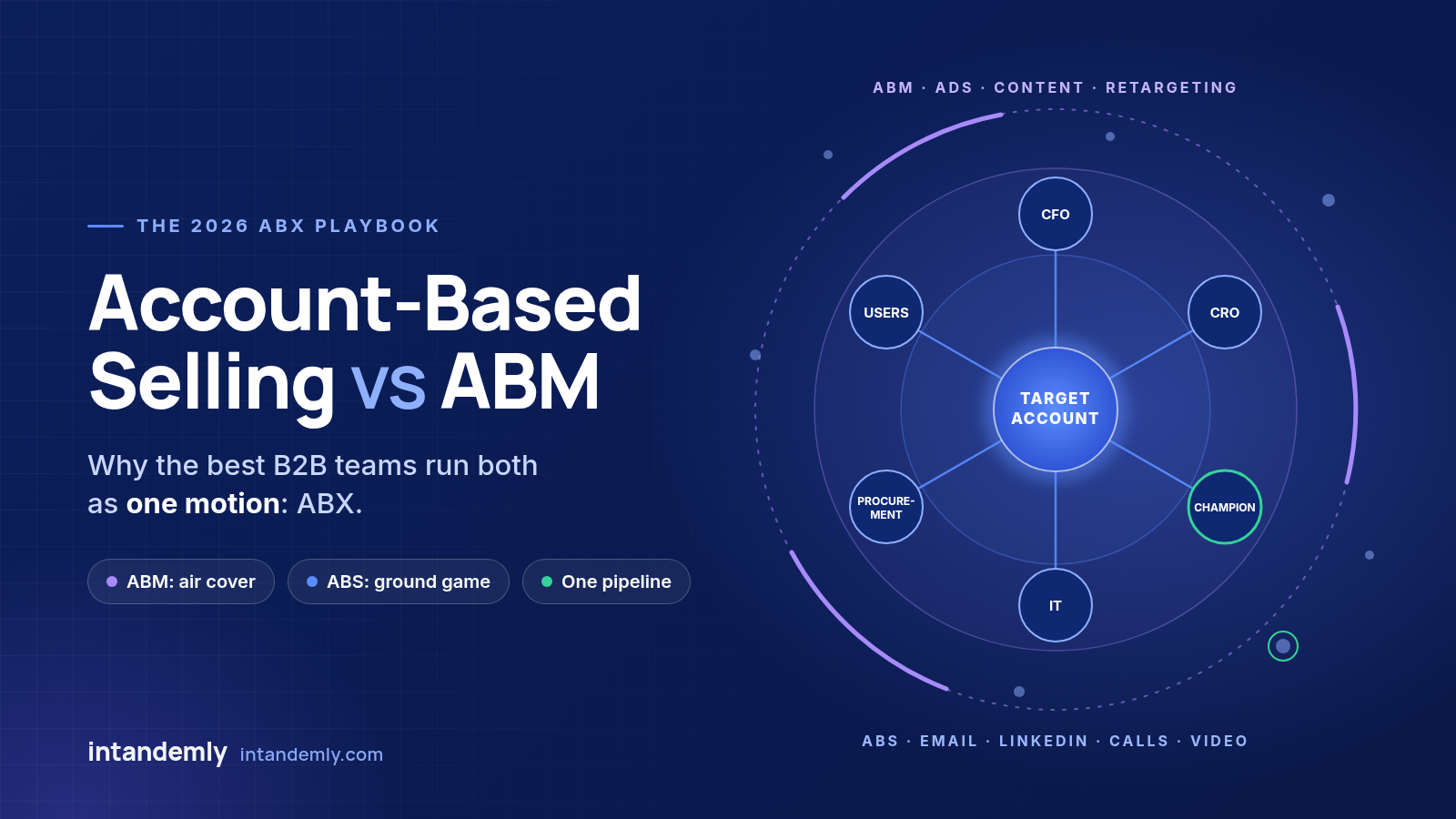
- Map the buying committee. For each important account, write down who owns the budget, who uses the product, who evaluates it and who can block it.
- Make the account aware. Show ads only to those companies, write content for each role, and run events or send direct mail for Tier 1.
- Measure by account. Report which accounts engaged, which roles you reached and what pipeline came from the list.
The order is the point. A team that starts at step 4 is running ordinary campaigns at a smaller audience and calling it ABM.
How is ABM different from lead generation and demand generation?
ABM starts from a list of companies. The other two start from an offer or a market and see who responds.
| Lead generation | Demand generation | ABM | |
|---|---|---|---|
| Starts with | An offer and a form | A market and a message | A named account list |
| Unit counted | Leads | Pipeline from the market | Accounts engaged |
| Who it reaches | Whoever responds | Everyone in the category | Chosen people in chosen companies |
| Suits | Short cycle, one buyer | Large market, many possible buyers | Long cycle, several decision-makers, high deal value |
The three are not rivals. Many companies run demand generation for the wider market and ABM for the accounts that matter most.
What are the three types of ABM?
The three types differ in how many accounts share one piece of work.
- One-to-one: a plan, content and outreach built for a single account. Used for the few accounts that could change your year.
- One-to-few: a cluster of similar accounts, such as regional banks replacing the same system, sharing one message with light tailoring.
- One-to-many: a few hundred accounts reached through targeted ads and sequenced content, personalised by industry or role.
Most programmes use all three, matched to Tier 1, Tier 2 and Tier 3.
When is ABM the wrong choice?
ABM is the wrong choice when the deal is small, one person can decide, or you cannot name your best-fit accounts. A lead-based funnel is simpler and cheaper in those cases.
It also fails when sales will not work the same list as marketing. ABM done by marketing alone produces engaged accounts that nobody calls.
Where does ABM stop and account-based selling start?
ABM stops when the account is aware of you and showing interest. Account-based selling starts when a named person is approached and a conversation begins. Both use one account list, one tiering and one committee map, which is why the two teams should build those together. Our account-based selling vs ABM playbook covers the handover in detail.
Intandemly works the selling half. We are an account-based selling company, not an ABM agency, and we write about ABM because our work begins where it hands over. The result is counted in accounts: for BEST SAP, which sells SAP finance add-ons, 800 accounts were reached and 22 were penetrated.
Why this works better on named accounts
A lead list tells you who responded. It says nothing about whether their company fits, who else must agree or why they would buy now. A named account list is chosen before any money is spent, so every advertisement, article and message lands on a company you wanted. When one contact loses interest, the account is still on your list and four other people are still worth reaching. ABM and account-based selling share that logic. Marketing makes the chosen account familiar with you, and selling starts the conversation with the people on the committee map. Spears, not nets.
Frequently asked questions
What is ABM in simple words?
ABM, or account-based marketing, means choosing the companies you want as customers first and then directing your marketing at the people who make decisions inside them. You market to a list of accounts, not to an anonymous audience.
Is ABM only for large companies?
No. ABM needs a product bought by several people over a long cycle and a team that can name its best-fit accounts. A small company can run it on a few dozen accounts with a spreadsheet and LinkedIn.
What is the difference between ABM and account-based selling?
ABM is the marketing half: choosing, tiering and warming accounts. Account-based selling is the direct half: named people are approached and conversations start. They share one account list and one buying committee map.
How do you measure ABM?
By account, not by lead. Count the accounts that engaged, the roles reached in each account, the conversations opened and the pipeline that came from target accounts. Clicks and impressions are diagnostics.
Keep reading
- Account-based selling vs account-based marketing
- The INTANDEM framework: six stages for working a named account
Want this run on your key accounts? Intandemly is an account-based selling company: a platform and a consultant who work your named accounts with you. Talk to us