How to Get Clients for a Software Company in India After Referrals Dry Up
To get clients for a software company in India once referrals slow down, stop waiting for enquiries and choose who you want. Pick one segment you have already delivered for, name 100 to 200 companies in it, find the three or four people who decide in each, and approach them with evidence from your past work. It is slower than buying a list and far more likely to end in a project.
Updated 10 Oct 2026.
Why do referrals dry up for software companies?
Referrals dry up because they depend on a small group of people, and that group stops growing. Many Indian software and IT services firms win their first years of work through the founder's old colleagues, two or three loyal clients and the occasional introduction. Then three things happen:
- Your champions move. The CTO who gave you three projects changes job, and the successor brings their own vendor.
- Your clients' networks are used up. Each happy client knows a handful of peers and has already mentioned you to them.
- You outgrow the source. A team of 60 needs more new work each quarter than a team of 15.
What do founders try next, and why does it stall?
Most founders try volume: more activity, aimed at nobody in particular. Each option has a place, but none replaces a decision about who you want as a client.
| What founders try | What it gives you | Where it stalls |
|---|---|---|
| Freelance marketplaces | Small projects, quickly | Buyers compare on price and the platform owns the relationship |
| A bought contact list and bulk email | Activity | Wrong people, weak data and a sender domain that mail filters learn to distrust |
| A lead generation agency paid per lead | Names and calls | A lead is one person. A software deal needs several people to agree |
| One new salesperson | Effort | No list, no message and no proof to work with, so they start from zero |
| Directory listings | Occasional enquiries | You are compared with 50 others on hourly rate |
How do you get clients for a software company in India without referrals?
You build a named account list and work it patiently. Five steps, in this order:
- Choose one segment where you have proof. Look at your last 10 projects. Which industry, company size and problem appear more than once? "Mid-sized NBFCs replacing a loan origination system" is a segment. "Companies needing software" is not.
- Name the accounts. List 100 to 200 companies that fit, by name. Score each on fit and timing, then sort them into Tier 1, Tier 2 and Tier 3 so your best effort goes to the best accounts.
- Map the buying committee. For each Tier 1 account, find the person who owns the budget, the person who feels the problem daily, the technical evaluator and procurement. One contact is a risk. Four is a position.
- Wait for a reason to write. A new CIO, a funding round, a new plant, a regulatory deadline or a hiring burst are trigger events. An approach tied to one reads as relevant, not random.
- Approach several people, on several channels, with one story. Email, LinkedIn and a phone call, each written for that person's role, each carrying the same evidence from a similar client.
Should you look for clients in India or abroad first?
Start where your proof is strongest, not where rates are highest. If your best three case studies are Indian companies, an Indian list will open faster, because your references are people the buyer can ring.
Indian enterprise buyers bring longer procurement cycles, vendor registration and payment terms that test your cash flow. Overseas buyers bring time zones, contracts in another jurisdiction and a higher bar for trust. Neither is easier.
How long does it take, and what should you measure?
Plan in quarters, not weeks. Software purchases involve several people and a budget cycle, so the early signs are conversations, not contracts. Measure the account, not the activity:
- Accounts reached: how many named accounts you have approached.
- Coverage: how many of the mapped people in each account you have contacted.
- Active conversations: two-way exchanges with someone in the buying committee.
- Accounts penetrated: accounts where a real conversation about a real need is under way.
- Pipeline: the value of opportunities inside named accounts.
These numbers are small. In one of our case studies, Bankai Infotech, a telecom software company, reached 818 accounts and penetrated 21 of them.
Why this works better on named accounts
A lead is one person who filled in a form or replied to a bulk email. You know little about their company, their budget or who else has to agree. A named account is a company you chose because it fits, where you know the people who decide and have a reason to speak to each of them. When a lead goes quiet, you have nothing. When one person in a named account goes quiet, you have three more doors to try and a reason to return next quarter. Referrals worked because they came with context and trust. Account-based selling builds both on purpose, with companies you selected.
Frequently asked questions
How do I get my first clients for a software company in India?
Start with people who already trust you: former employers, colleagues and anyone you have delivered work for. Take two or three projects in one industry, even small ones, and write up the results. That proof is what lets you approach named accounts in the same industry later.
How many target accounts does a small software company need?
Between 100 and 200 named accounts is enough for one person to work properly. A longer list tempts you back into bulk messaging. A much shorter one leaves too little room for timing.
Is cold email still worth it for Indian software companies?
Yes, when it goes to a named person at a chosen company, mentions something true and current about that company, and comes from a properly set up domain. Bulk email to a bought list harms your domain and seldom reaches a decision-maker.
Should a software company hire a salesperson or use an outside partner?
Either can work if the account list, the message and the proof exist first. Without them, a new hire or a partner spends the first months building them. Decide who owns the list before you decide who works it.
Keep reading
- Lead generation vs account-based selling
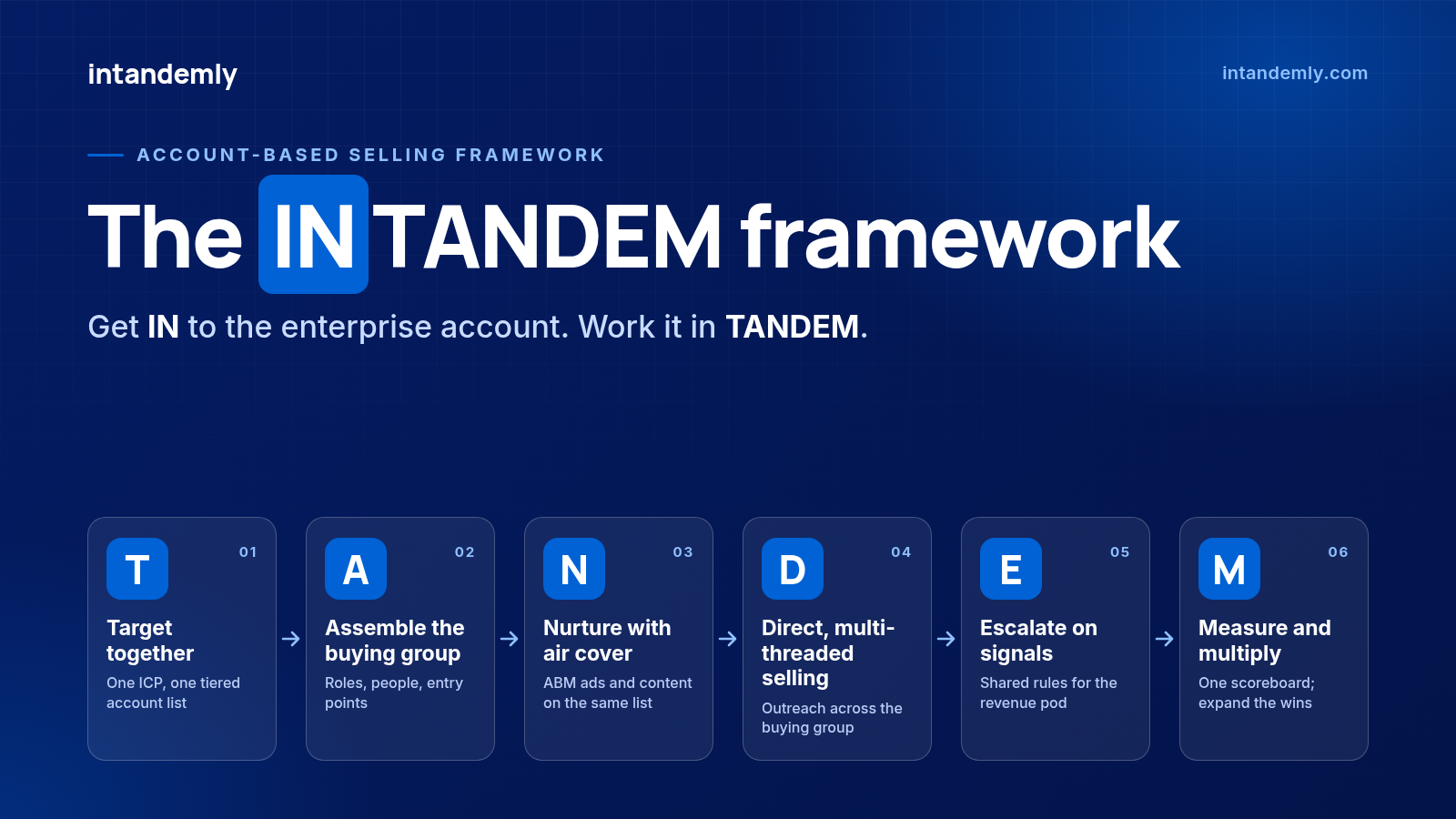
- The INTANDEM framework: six stages for working a named account
Want this run on your key accounts? Intandemly is an account-based selling company: a platform and a consultant who work your named accounts with you. Talk to us